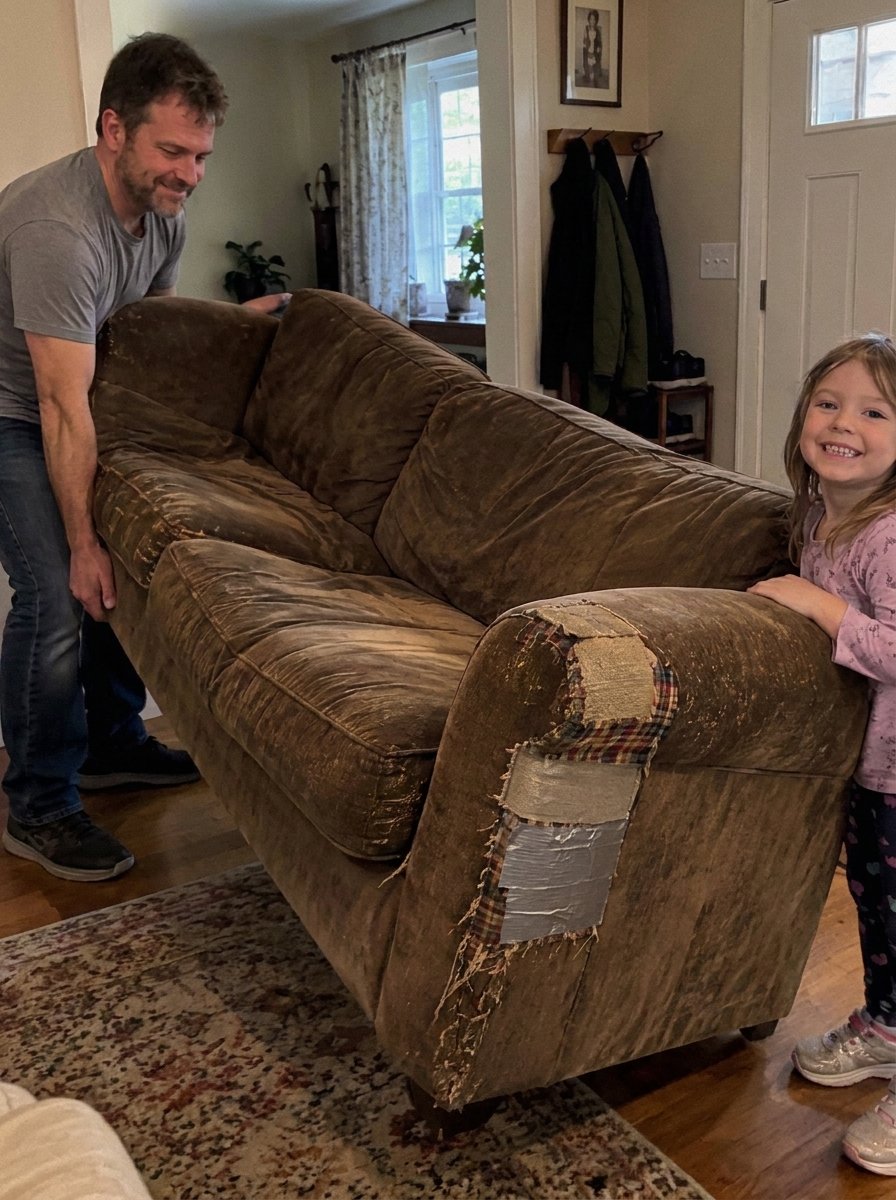
After my husband, Arthur, passed away, I struggled to let go of the belongings that reminded me of our 36 years together. Even the old brown couch, which I’d spent two decades begging him to replace, had become something I couldn’t imagine living without.
Eventually, I decided it was time to move forward. Selling that couch felt like a small step toward reclaiming my life.
But I never imagined that getting rid of an old piece of furniture would uncover a secret my husband had kept for years – one that would bring back our family’s most painful memories and reveal something I hadn’t understood about the people I loved.
The young man who bought Arthur’s couch returned the very next morning.
He stood in my kitchen holding a package wrapped in yellowed tape.
“I think you should have your money back,” he said.
I looked at him, confused.
“Did the couch break already?”
“No, Monica. But I found something inside.”
He held out the package.
My name was written across it in Arthur’s unmistakable handwriting.
My husband had been gone for six months.
I stared at the writing, unable to understand what I was looking at.
“What is that?” I asked.
The young man shook his head.
“I was hoping you could tell me.”
Whatever Arthur had hidden inside that couch, he had never mentioned it to me.
And when I finally opened the package, I began to understand why.
For 20 years, I’d begged Arthur to replace that awful brown couch.
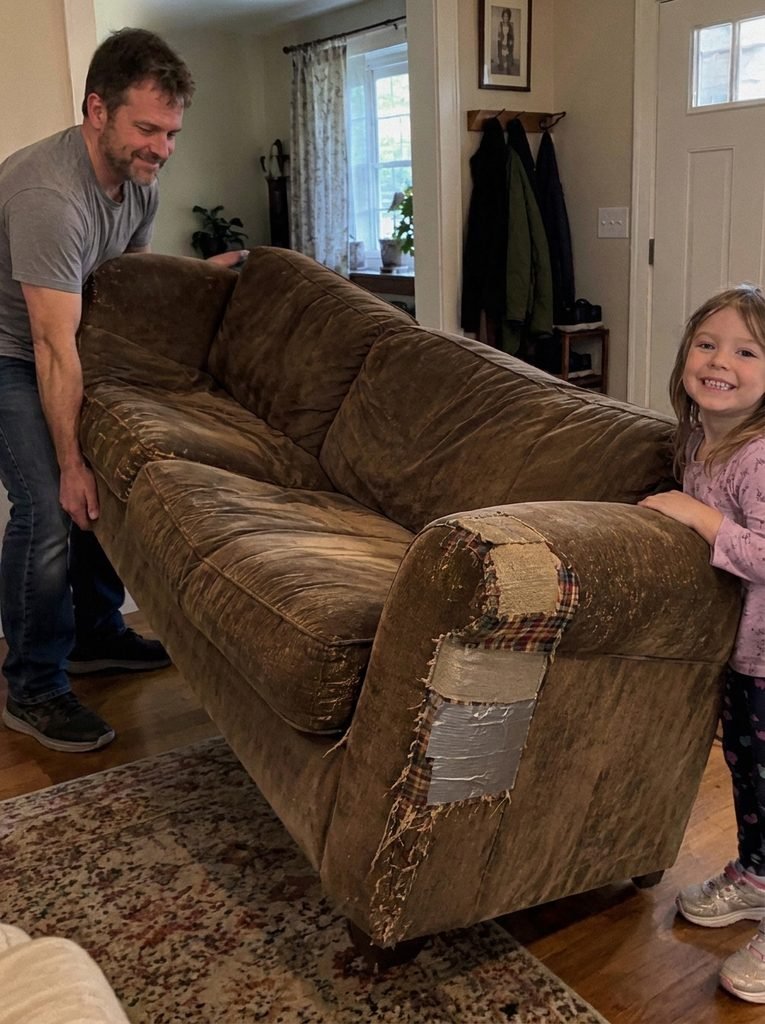
The middle cushion sagged so badly that sitting down felt like sinking into a hole. The armrest had three patches, and getting up required a rocking motion that made me feel twice my age.
“Arthur, we’re buying a new couch,” I’d tell him.
He would simply pat the cushion beside him.
“This one makes you sit closer to me, Mon.”
“That’s because the springs are trying to swallow us.”
He’d laugh, reach for my hand, and pull me down beside him.
Arthur had been my husband for 36 years. He could repair almost anything, and unfortunately, he believed absolutely everything deserved to be repaired.
If a chair wobbled, he fixed it. If a drawer stuck, he took it apart. If something broke, he refused to replace it until he’d exhausted every possible way to bring it back to life.
That old couch was no exception.
Then Arthur died.
Suddenly, the piece of furniture I’d complained about for two decades became the only place in the house where I could sleep.
I’d curl up on his side beneath his blanket, leaving the television on until morning. Sometimes, I’d wake up in the middle of the night and reach toward the empty space beside me before remembering he wasn’t there.
Our daughter, Aurora, eventually decided she couldn’t watch me continue like that.
“Mom, you can’t keep sleeping out here.”
“I’m comfortable, honey.”
She looked at the couch.
“You complained about that thing for half my childhood.”
“People change.”
Aurora was 29. She had inherited her father’s dry sense of humor and my stubborn streak. She sat beside me and gently took my hand.
“Dad wouldn’t want you sleeping with the remote digging into your back.”
I almost smiled.
Then she added something that stayed with me.
“You don’t have to keep everything exactly as he left it.”
That evening, I finally listed the couch online for $40.
I nearly deleted the listing three times.
It felt strangely wrong to put a price on something Arthur had spent so many years repairing. But I knew Aurora was right. I couldn’t spend the rest of my life preserving every object simply because it reminded me of him.
The following afternoon, a young man named Josh arrived with his friend Liam and his little daughter, Emma.
Emma climbed onto the cushions almost immediately.
“Daddy, look! We both fit!”
Josh smiled as he looked around the old couch.
“I’ve been furnishing our apartment since my divorce. We’ve been watching cartoons on the floor.”
He handed me $40.
I looked at the little girl and returned $20.
“Buy her something nice, sweetheart. She deserves a treat on her new couch.”
Josh seemed surprised.
“Are you sure?”
“Take it before I change my mind.”
Liam helped him carry the couch outside.
As they lifted it through the doorway, I almost called them back.
I stood there watching Arthur’s favorite seat disappear, suddenly overwhelmed by the realization that something which had been part of our home for so long was now gone.
But I didn’t stop them.
That night, for the first time in six months, I slept in our bed.
I thought that was the end of the matter.
Then Josh appeared at my door the next morning.
He looked uncomfortable as he explained what had happened.
“Emma dropped a pencil between the cushions last night,” he said. “I turned the couch over to get it, and I noticed the fabric underneath had been sewn shut by hand.”
I nodded.
“Arthur repaired that thing constantly.”
“That’s what I figured. But one seam looked newer.”
He placed the package on my kitchen table.
“Did you know what he was hiding inside?”
I shook my head.
Josh hesitated before continuing.
“I opened the wrapping. I read the first few lines before I realized it was private. I’m sorry.”
I looked at him, then at the package.
He pushed the $20 I’d given him toward me.
“Emma loves the couch, but if you want it back, I’ll bring it over.”
I shook my head.
“Keep the couch, Josh. She needs somewhere to watch her cartoons.”
He nodded, clearly unsure what else to say.
After he left, I found a pair of scissors and carefully began cutting through the yellowed tape.
Inside was a thick stack of handwritten pages, held together with rubber bands.
A letter rested on top.
The first thing I noticed was the date.
June 14.
Maisie’s birthday.
Our first daughter would have turned 33 that year.
But Maisie had lived for only eight months.
Beneath the date, Arthur had written a sentence that made my hands tremble.
“I couldn’t tell you this while I was alive.”
I slowly sat down.
“Arthur, what have you done?”
The next page had a title:
The Life We Didn’t Get.
Below it was another heading:
Maisie’s Fifth Birthday.
I stared at the words.
For years, Arthur and I had tried to make peace with the birthdays Maisie never got to celebrate. We’d learned to live with the empty space her absence left in our family, although neither of us had ever truly stopped missing her.
Yet here was Arthur, imagining every birthday she might have had.
I turned the page.
The first chapter described a little girl refusing to wear matching socks.
“Nobody can see them inside my shoes,” Maisie argued.
“They’ll know,” her mother replied.
“Then they shouldn’t be looking.”
I laughed quietly.
Arthur had given her my stubbornness.
In his imagined story, Maisie wanted a chocolate birthday cake. Arthur bought one with raspberries, which she hated. She refused to eat until he removed every single raspberry.
Then I reached a sentence that stopped me.
“Monica watched our daughter blow out five candles. For once, she didn’t have to wonder what this birthday might have looked like.”
I lowered the pages.
Arthur had imagined a birthday that had never happened.
He had imagined Maisie at five, standing in front of a cake, blowing out candles while we watched.
I kept reading.
At eight, she learned to ride a bicycle.
At 12, she wanted to become a veterinarian.
At 16, she brought home a boy Arthur disliked because he called him “buddy.”
I laughed again.
Arthur couldn’t stand that word.
“Oh, Arthur,” I whispered.
But the farther I read, the more unsettled I became.
He hadn’t simply written a few memories or imagined one birthday. He had created an entire life for our daughter.
There were school dances, arguments, holidays, her first apartment, and even her wedding.
How long had he been writing this?
And why had he never told me?
I carried the manuscript into our bedroom.
Arthur’s desk stood beside the window. I’d barely opened it since he died. His old batteries were still in the first drawer, arranged exactly as he had left them.
The second drawer contained three notebooks. One of them held 12 years of writing notes.
I began reading the entries.
“Maisie learns to swim.”
“First terrible haircut.”
“Monica teaches her to drive.”
I turned through the pages slowly, realizing that Arthur had been keeping track of every imagined milestone.
Near the back, I found a sentence that made me stop.
“Hid manuscript in couch. Need courage to show Monica.”
Below it was another sentence he’d underlined:
“Don’t make her perfect.”
That detail surprised me.
Arthur hadn’t imagined a daughter who never argued, never made mistakes, or always did what her parents wanted. He had given Maisie a personality of her own.
She could be stubborn, funny, difficult, and occasionally unreasonable.
He had imagined her as a real person, not an idealized child.
I picked up the manuscript again and found the wedding chapter.
Maisie stood before a mirror while I fastened her dress.
“Mom, you’re making that face.”
“What face?”
“The one you make when you’re trying not to cry.”
Arthur had noticed that about me.
I sat there for a long time, imagining the scene he had written.
All those evenings on the couch, while I complained about the springs and the worn-out cushions, he had been imagining Maisie growing up.
But then another thought entered my mind.
What about Aurora?
Our living daughter had grown up right in front of us. She had experienced birthdays, school years, first dates, arguments, and all the ordinary milestones that make up a childhood.
Had Arthur written about her, too?
I grabbed my keys.
I needed to understand why he had spent so much time writing about one daughter while apparently leaving the other outside those pages.
Aurora opened her apartment door.
“Mom? What’s wrong?”
I held up the manuscript.
“Your father wrote something I never knew about.”
She stepped aside.
“Come in. I’ll make coffee.”
“Please don’t make that expensive stuff you bought me last time.”
“It’s regular coffee, Mom.”
“It tasted like burnt toast.”
She laughed and headed into the kitchen.
I placed Arthur’s manuscript on the table.
Aurora noticed the title immediately.
“Dad wrote this?”
“He did.”
She turned several pages, reading the headings.
“About Maisie?”
“About what her life might have been.”
Aurora read quietly for a while before looking up.
“I wish he’d shown me.”
“Why?”
“Because I would’ve liked to know more about her.”
I reached for her hand.
“Honey, Maisie was gone before you were born. We didn’t get to know enough about her either.”
“I wasn’t asking you to change that.”
“Then what are you asking?”
Aurora closed the manuscript.
“Why was it so hard to talk about her?”
I frowned.
“We talked about Maisie.”
“Not really, Mom.”
I immediately wanted to disagree, but Aurora continued.
“When I was six, I found her photograph in Dad’s drawer. Remember?”
I did.
Maisie was wearing a yellow onesie covered in little ducks, holding onto Arthur’s finger.
“You told me she was my sister,” Aurora said. “Then you put the photograph away.”
“I didn’t want to upset you.”
Aurora looked at me.
“I was six, Mom. I just wanted to know whether she looked like me.”
“Your father and I did our best.”
“I know. But I’m trying to tell you what it felt like, and you keep telling me why you did it.”
I looked away.
Then I stood up.
“I should go.”
“Mom, please don’t leave because we disagree.”
But I picked up my purse.
I wasn’t ready to hear anything else.
Halfway home, I pulled into a parking lot and sat quietly in the car.
I kept thinking about Aurora at six years old, holding Maisie’s photograph.
“Would she have played with me?” she’d asked.
“Probably, sweetheart,” I’d answered.
Then I’d put the picture away, believing I was protecting her from something too painful for a child to understand.
Now I wondered what she had understood from my silence.
I took out my phone and called her.
“Mom?” she answered.
“I shouldn’t have walked out. I’m sorry.”
She was quiet.
“I didn’t like hearing that we made you feel shut out,” I admitted.
“I wasn’t trying to hurt you.”
“I know. I’d still like to hear the rest.”
“Are you sure?”
“Come for dinner tomorrow. We can talk properly.”
After a brief pause, she agreed.
I put down the phone and looked at Arthur’s manuscript on the passenger seat.
I wasn’t finished with it.
But I couldn’t keep reading his words while ignoring my daughter’s.
The following evening, Aurora arrived carrying dessert.
“I brought pie,” she announced.
“I made chicken.”
“Good. I was worried you’d serve the manuscript.”
I laughed and took her coat.
Over dinner, I eventually put down my fork.
“Tell me what you remember about Maisie.”
Aurora looked surprised.
“Honestly?”
“Especially honestly.”
She thought for a moment.
“I remember Dad going quiet every June. And I remember you avoiding the photo albums.”
I nodded.
“I couldn’t look at them sometimes.”
“I figured that out when I got older.”
“What did you think when you were little?”
Aurora moved her potatoes around her plate.
“Sometimes I thought you wished our family had turned out differently.”
I reached across the table.
“Aurora, we never wished you away.”
“I believe you, Mom. I’m just telling you what it felt like.”
“Then why didn’t you ask us?”
“Because whenever I mentioned Maisie, you looked so sad. I even drew a picture of all four of us once, but I threw it away. I thought it might upset you.”
Her words hit me harder than I expected.
I’d stayed silent because I thought I was protecting her.
She had stayed silent because she thought she was protecting me.
“I’m sorry,” I said.
Aurora squeezed my hand.
“I wish we’d spoken about her more.”
I looked toward the manuscript.
“There’s something I haven’t figured out about your father’s book.”
“What?”
“Why he spent so many years writing about the life Maisie never had.”
Aurora considered that for a moment.
“Maybe he wanted to know her, too. And maybe that’s how he tried to heal from her.”
I hadn’t thought of it that way.
After dinner, I walked her to the door.
“Can I read the rest when you’re finished?” she asked.
“Of course.”
“And Mom?”
“Yes?”
“I don’t need you to have every answer. I never did.”
I hugged her.
“That’s fortunate, because I’m running short.”
That night, I returned to Arthur’s manuscript.
I read about Maisie leaving for college and calling home after ruining her laundry. I turned another page, expecting to find another chapter about the life she might have lived.
But the heading was different.
Aurora’s First Bicycle.
I frowned.
This wasn’t part of Maisie’s imagined life.
I began reading.
Aurora was seven when Monica decided she was ready to ride without training wheels.
I remembered that afternoon.
Arthur wanted to wait.
I’d insisted she could manage.
Aurora fell twice before she finally rode across the driveway.
Arthur described me running beside her, shouting encouragement as she struggled to keep her balance.
Then came the moment when Aurora turned around.
“Did you see me, Daddy?”
Arthur had written:
“I saw her. And I saw Monica laughing as she ran after our girl.”
I turned the page.
The next heading read:
The Birthday Cake Disaster.
Aurora was ten.
She had confused salt with sugar while making Arthur’s birthday cake. He’d eaten two bites before admitting something was wrong.
I laughed until my eyes watered.
The next heading was:
The Day Monica Sang Again.
Arthur wrote about Aurora making up silly words to a song while I washed dishes.
I’d joined in without realizing it.
He had been standing in the doorway, listening.
“I’d forgotten how much I missed hearing Monica sing,” he had written.
I stopped reading.
The first half of the manuscript imagined the life Maisie never had.
The second half recorded the life we’d actually lived.
Arthur hadn’t forgotten about Aurora.
He’d been writing about both daughters.
I continued turning the pages, suddenly seeing the manuscript in an entirely different light.
The final pages contained a letter.
“Monica,
“I was afraid you’d read the beginning and think I wanted that life more than ours.
“I didn’t.
“I wanted Maisie to grow up. I wanted to hear her argue about homework and complain about my cooking.
“But I never wished Aurora away.
“When she was born, I loved her for who she was. Not because she could replace anyone.
“I wrote about Maisie because I wanted to imagine the things we’d missed.
“I wrote about Aurora because I didn’t want to forget the wonderful things we had.
“And I wrote about you because, even when we couldn’t talk about everything, I loved the life we made.
“I wish I’d been brave enough to show you.”
I lowered the page.
For a moment, I couldn’t move.
I remembered Arthur carrying Aurora around the house when she was a baby, making up songs because he’d forgotten every lullaby he knew.
“You certainly loved making a fool of yourself for her,” I whispered.
I turned back to the letter.
Arthur had never been choosing one daughter over the other.
He had been trying to preserve two different kinds of love: the life he’d wished Maisie could have lived and the life he had been fortunate enough to share with Aurora.
He had found a way to remember both girls.
And somehow, he had found a way to remember me, too.
I touched the final sentence.
“You could’ve shown me, you stubborn man.”
Then I remembered walking out when Aurora had tried to tell me something painful.
This time, I picked up my phone and called her.
“Can you come over tomorrow?”
“Is everything okay?”
“Yes. But there’s something in your father’s book I want you to read.”
“Did you find something else?”
“I found something about us.”
Aurora was quiet for a moment.
“Then I’ll come after lunch.”
The following afternoon, she arrived.
I handed her the final chapters and watched as she read about her bicycle, her ruined birthday cake, and the afternoon Arthur had heard me singing.
Then she reached his letter.
When she finished, she wiped her cheeks.
“He remembered all of that?”
“Apparently, your father remembered more than either of us gave him credit for.”
She smiled.
“Do you think he wished Maisie was here instead of me?”
I moved closer.
“No, sweetheart. He wished both his girls were here.”
Aurora leaned against my shoulder.
I opened the manuscript again.
“There’s one chapter I haven’t read yet.”
She looked at the heading.
The Day You Came Home.
“Did Dad really remember the day I was born that clearly?” she asked.
“He forgot where he parked the car that morning,” I replied.
Aurora laughed.
I turned the page.
“But I think he remembered everything else.”
She pulled her chair closer, and together we began reading.
For the first time, Arthur’s hidden manuscript no longer felt like a secret separating us. It felt like something he had left behind to bring us closer – a record of the daughter we lost, the daughter we raised, and the family we had built through all the joy and heartbreak.
I had sold the couch because I thought it was time to let go of the past.
Instead, it brought back memories I’d buried, conversations I’d avoided, and a truth I needed to hear.
Arthur had spent years writing about the life we never got to live with Maisie, but he had never stopped cherishing the life we shared with Aurora.
And perhaps that was the part I needed to understand most.
We didn’t have to choose which memories to keep.
We could miss Maisie and still celebrate Aurora. We could grieve the life that never happened while being grateful for the one that did.
Arthur had kept those pages hidden because he was afraid I wouldn’t understand.
I wished he had trusted me enough to share them while he was still here.
But as Aurora and I sat together, reading his words, I finally understood something else.
Sometimes, letting go of an old possession doesn’t mean letting go of the person who left it behind.
Sometimes, the things we think we’re ready to throw away are carrying the very memories we still need to find.