My Daughter-in-Law Threw Me Out of the House I Spent 20 Years Paying For, But When I Opened the Door the Next Morning, I Realized She Had Made the Biggest Mistake of Her Life
Every Stitch
Part One: The Apron
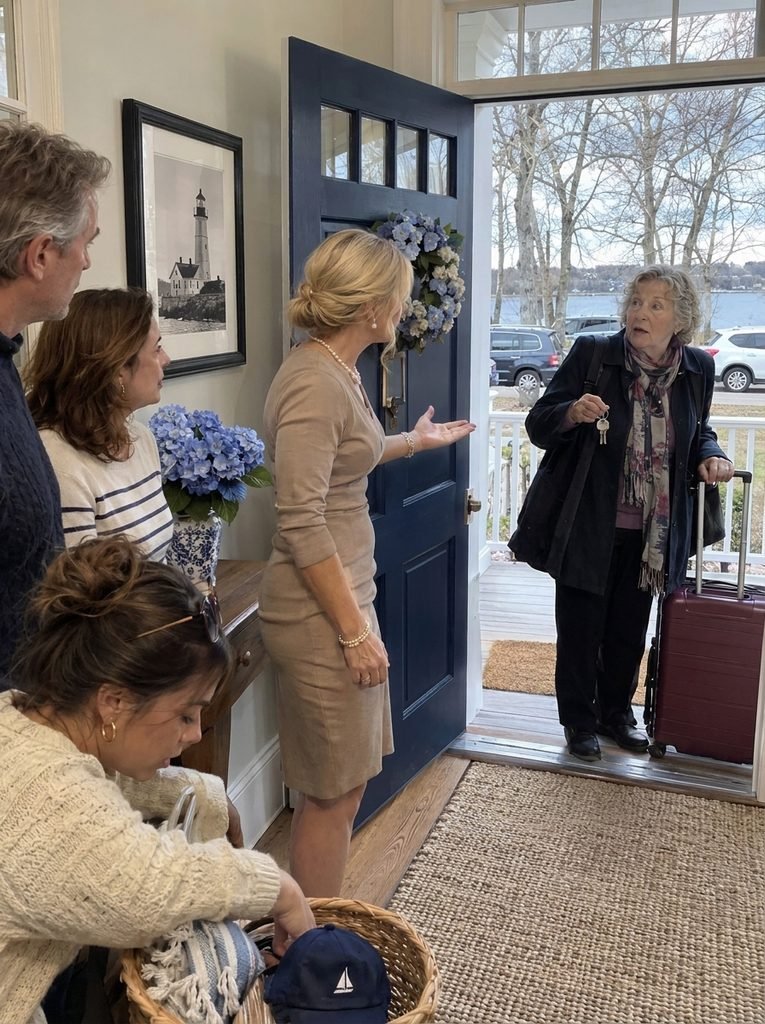
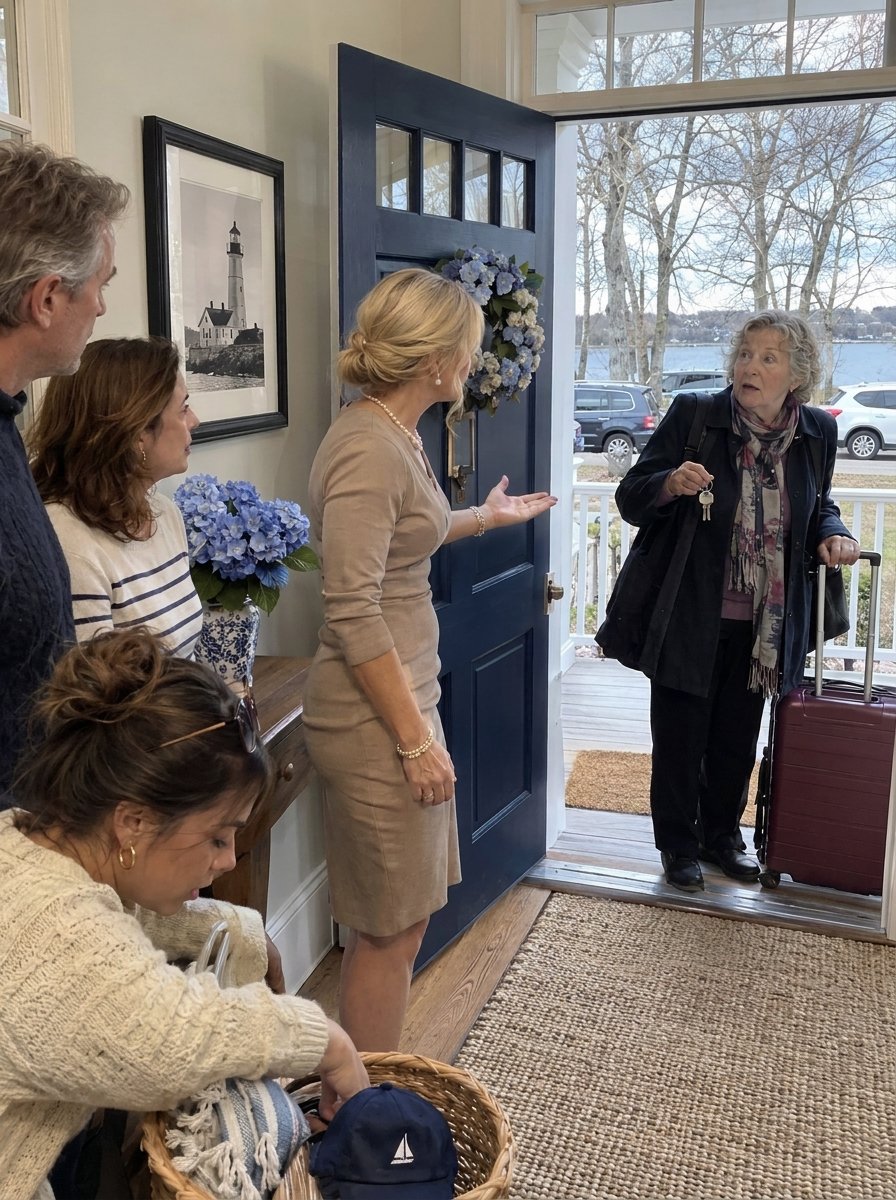
My daughter-in-law was standing in the doorway of my beach house in Newport, Rhode Island, wearing my favorite embroidered apron when she told me I couldn’t stay.
It was a white linen apron with a border of blue hydrangeas I’d stitched myself, by hand, over three winters in Philadelphia, sitting by the radiator in my apartment on Catharine Street after work. I’d made it the year I put the down payment on this house. I’d worn it every morning I’d spent here since.
Tiffany had tied it around her waist over a pair of white jeans. She held the front door open about halfway, with one hip leaning against the frame, and she smiled at me the way a hotel clerk smiles at a guest whose reservation has been lost.
“I’m so sorry, Rosalind,” she said. “My family’s already here. We just don’t have room for another guest this week.”
I was standing on my own front steps with my suitcase in one hand and a grocery bag in the other. I’d driven four and a half hours from Philadelphia that morning, through traffic on I-95, through the Connecticut rain. In the bag were things for the week: a loaf of rye from the Italian Market, a jar of my own blackberry jam, a box of the good Earl Grey.
Behind Tiffany, through the half-open door, I could see into my house.
A woman in her sixties with frosted hair was opening and closing my kitchen cupboards one after another, looking for something. A younger woman was stretched out on my sofa with her feet up on the arm, scrolling her phone. Three or four children were running back and forth across the back terrace beyond the French doors, shrieking. Out in the gravel drive behind me were three SUVs I’d never seen before.
A guest. That’s what she called me. In the house I’d spent twenty years with a needle in my hand to buy.
Part Two: The Needle
I’m Rosalind Abbott. I’m seventy years old.
I was forty-eight when my husband, Winston, died of a heart attack on the platform of the Broad Street subway, on his way home from his job as a machinist at the Navy Yard. He left me a two-bedroom rowhouse in South Philadelphia, a small life insurance policy, a fourteen-year-old son, and a Singer Featherweight sewing machine from 1951 that had belonged to his mother.
I’d always sewn. My mother taught me in Kingston, Jamaica, when I was seven, on the back porch of our house on Hope Road. After Winston died, sewing became how I made a living.
For twenty years, I worked out of a little storefront on Passyunk Avenue. Abbott Alterations & Bridal, in gold letters on the window. I made wedding gowns for South Philly brides whose mothers couldn’t afford Kleinfeld’s. I hemmed police uniforms and nurses’ scrubs. I let out the waistbands of men’s suit pants after Thanksgiving and took them back in after Lent. I replaced zippers and turned collars and rebuilt prom dresses that came in torn.
Six days a week, ten hours a day. Every Sunday after church, I’d sit at my kitchen table with a ledger and count what was left. Whatever I could spare went into a savings account at the Philadelphia Federal Credit Union, in a passbook with a blue cover I kept in my nightstand drawer.
On the front of that passbook, in pencil, I’d written one word. Ocean.
When I was fifty-nine, I had enough.
I found the house on a real estate website late one night. A small gray-shingled cottage on a quiet lane in Newport, about a mile from the water, with white trim and a wraparound porch and a garden gone to weeds. It had been empty for three years after the old woman who owned it died. The listing said needs work.
I drove up on a Sunday and stood in the overgrown front yard with the real estate agent. I could smell salt in the air and hear gulls. I bought it that afternoon.
Part Three: Restoring It
It took me eleven years to make that house what it is.
I drove up from Philadelphia every other weekend, and for two weeks every August, and every spring between Easter and Mother’s Day when the bridal season was slow. I stripped and refinished the old oak floors myself on my hands and knees. I painted every room. Pale blue in the bedrooms. Buttercream in the kitchen. White in the hall.
I bought furniture at estate sales across Rhode Island and Massachusetts and restored it in the garage: a mahogany sideboard from Little Compton, a pair of wingback chairs from Tiverton, which I reupholstered myself in a blue-and-white toile. I sewed every curtain in the house, every cushion, every pillow.
And I brought the garden back. The old woman had planted hydrangeas along the whole front of the porch, decades ago, and they’d gone wild. I cut them back and fed them and coaxed them for three summers until they bloomed again, blue and purple and white, so heavy they bent to the ground. That’s where the pattern on my apron came from.
The small back bedroom, the one that looks out over the garden, I made into my sewing room.
Winston’s mother’s Singer Featherweight sits on an old oak table by the window. On the shelves around it are my thread and my fabric and my pattern books. In a cedar chest under the window is my wedding dress, the one I made myself in Kingston in 1975, ivory silk with a hundred and twelve covered buttons down the back. And a shoebox tied with ribbon full of Winston’s letters from when he was courting me, written from the Navy Yard to Jamaica, every week for two years.
That room was mine. That house was mine. It was supposed to be the quiet place I’d spend the rest of my life.
Part Four: Peter
My son, Peter, has a key.
He’s forty-two now. He grew up in that rowhouse on Catharine Street watching me work. He did his homework at a folding table in the back of my shop on Passyunk Avenue while I pinned hems. He was the one who drove me to Newport the day I bought the cottage. He cried when he saw it.
“You did it, Mom,” he said, standing on the overgrown porch. “You really did it.”
Peter is a commercial fisherman. He crews on a scallop boat out of New Bedford, Massachusetts, forty minutes from Newport. Ten to fourteen days at sea, then a week home, then out again. He and his wife, Tiffany, live in a small house in Fairhaven, across the harbor from New Bedford, with their daughter, Isla, who’s eight.
I gave Peter a key to the Newport house five years ago, for emergencies. Sometimes he and Tiffany and Isla stayed there for a weekend in the summer. But they always asked me first. Always. Mom, is it okay if we use the cottage this weekend? And I always said yes.
I never once invited Tiffany’s relatives to stay. I’d met her mother exactly twice.
“Peter knew I was coming today,” I said to Tiffany, standing on my own front steps with my suitcase. “I told him last week. Before he went out on the boat.”
Tiffany didn’t even blink.
“He must have forgotten,” she said. “He’s got so much going on, Rosalind. You know how it is. The boat.”
Part Five: “All Right”
The house behind her had gone strangely quiet. The woman in my kitchen had stopped opening cupboards. The woman on my sofa had looked up from her phone. Even the children on the terrace had stopped running. They were all looking at me, waiting, I think, for the old woman on the steps to lose her temper.
I didn’t give them that.
“All right,” I said. “I’ll stay somewhere else tonight.”
Tiffany looked relieved. Visibly. Her shoulders came down. She actually smiled at me.
“Thank you so much for understanding,” she said. “It’s just for a few days.”
She shut the door.
I stood on my front steps for a moment longer, looking at the hydrangeas along the porch. They were brown and bare in February, cut back for the winter, the way I’d left them in November.
Then I picked up my suitcase and my grocery bag and walked back to my car.
I drove into town and checked into the Hotel Viking on Bellevue Avenue. Room 314, with a view over the rooftops toward the harbor and the cold gray winter sea. I sat in a chair by the window with my coat still on and my suitcase by the door and watched the light go down over the water.
I thought about Peter.
He grew up in the back of my shop. He used to sit under my cutting table with a box of buttons, sorting them by color, while I worked until nine at night. He watched me save for twenty years. He knew what that house cost. Not in dollars. In hours.
I wanted to believe he had no idea what his wife was doing. I sat in that hotel chair until midnight, wanting to believe it.
Part Six: The Lock
The next morning, I drove back to my house at nine o’clock.
The three SUVs were still in the gravel drive. One of them had a Connecticut license plate. Another had New York plates. I parked on the street.
I walked up the front steps with my key in my hand. My old brass key on a ring with a little silver thimble charm Winston gave me for our tenth anniversary. I put it in the lock.
It didn’t go in.
I tried again. It stopped halfway, catching on something.
I bent down and looked closer.
The old bronze lockset, the one that came with the house, the one with the little scrolled escutcheon plate I’d polished with Brasso a dozen times, was gone. In its place was a bright new brass deadbolt. And above it, mounted on the door frame, a black electronic keypad with a little glowing blue light and a camera lens in the middle.
They had changed the locks. On my house.
I rang the doorbell. Nothing happened. I rang it again. And again.
After the fourth ring, I heard footsteps. The door opened about four inches and stopped with a jerk. There was a brass security chain across the gap. That hadn’t been there yesterday either.
Tiffany peered out at me through the four-inch gap. She was still wearing my hydrangea apron.
“Rosalind,” she said. “It’s nine in the morning.”
Part Seven: The Chain
“Why did you replace my locks?” I asked.
Tiffany sighed. “Peter thought we needed better security,” she said. “There have been break-ins on the island this winter.”
“This is my house, Tiffany,” I said. “Not Peter’s. Mine. My name is on the deed. Nobody changes the locks on my house without asking me.”
Her face tightened. The pleasant hotel-clerk smile disappeared.
“Rosalind,” she said. “Please stop causing trouble.”
“Then let me in.”
“No.”
She shut the door. I heard the deadbolt turn. I heard the electronic keypad beep twice.
I stood on my own front porch in the cold February wind coming off the water, with my old brass key in my hand and Winston’s silver thimble swinging from the ring, and I didn’t know what to do.
I’d sewn a hundred and fifty wedding gowns. I’d let out ten thousand waistbands. I’d buried a husband. I’d raised a son alone. I’d never once in my life been locked out of my own front door.
“Rosalind! Rosalind, over here!”
It was Margaret Hargrove, calling from the porch of her house two doors down. Margaret is eighty-one, a retired Latin teacher from the Rogers High School, who’s lived on the lane for fifty-two years. She was standing on her front steps in a bathrobe and a quilted vest and snow boots, waving at me with both arms.
“Come over here,” she called. “Right now. There’s something I need to show you.”
Part Eight: Margaret’s Kitchen
Margaret’s kitchen smells like coffee and old books. She sat me down at her table by the window and poured me a cup of coffee without asking. Then she sat down across from me with a tablet in a leather case.
“I’ve been meaning to call you since October,” she said. “But I didn’t have your number in Philadelphia, and Peter told me you’d changed it.”
“I haven’t changed my number,” I said.
Margaret looked at me over her reading glasses for a long moment.
“No,” she said. “I didn’t think so.”
She opened the tablet. She tapped on an app with a little doorbell icon.
“My grandson installed one of these video doorbells last spring,” she said. “It records the whole street. I never look at it except when the mail’s late.” She tapped the screen. “But in October, I started noticing things. So I started looking.”
She turned the tablet toward me.
The first clip was dated two days before. A white van in my driveway. Two men in work clothes carrying a toolbox up my front steps. One of them knelt down at my front door. A few minutes later, he stood up holding my old bronze lockset in his hand. The other man was mounting something on the door frame. The electronic keypad.
Tiffany was standing on the porch in a parka, supervising. She handed the first man a check.
The second clip was from a week before Christmas. A silver minivan with Massachusetts plates pulled into my driveway. A family got out. A man, a woman, three teenagers. They pulled suitcases out of the back. The man walked up to my front door, punched a code into the keypad, and went inside.
“I’ve never seen them before in my life,” I said.
“Neither had I,” Margaret said. “They stayed four days.”
She tapped another clip. And another. And another.
A young couple with a dog and a Volvo with Vermont plates, in November. A group of six women in their forties with matching sweatshirts that said BACHELORETTE WEEKEND, in October. A family with two little kids and a New Jersey license plate, at Thanksgiving. A man alone in a rental car, in early January, carrying a laptop bag and a golf umbrella.
Group after group. Car after car. Suitcases going in and suitcases coming out.
“Since September,” Margaret said quietly. “Every weekend. Sometimes during the week too. I’ve counted twenty-three different groups.”
My stomach went cold.
Strangers. Strangers in my house. Sleeping in my beds under the quilts I’d made. Sitting in my reupholstered wingback chairs. Eating at my mahogany sideboard. Treating the house I’d spent twenty years of my life sewing for like a hotel.
I turned to Margaret.
“How long?” I whispered. “How long has this been going on?”
Part Nine: The Listing
“Since September,” Margaret said again. “At least. That’s when I started noticing.” She took off her reading glasses. “But that’s not the worst of it, Rosalind.”
She tapped the tablet. She opened a web browser. She typed something.
Then she turned the screen toward me again.
It was a vacation rental website. One of the big ones. The page was full of photographs.
Photographs of my house.
My front porch with the hydrangeas in full bloom, blue and purple, from last July. My living room with the toile wingback chairs and the white curtains I’d sewn. My kitchen, buttercream yellow, with copper pots on the wall. My bedroom with the hand-stitched quilt on the bed. My back terrace with the view of the garden.
At the top of the page, in large elegant script:
The Hydrangea House — Charming Newport Cottage, Steps from the Sea. Hosted by Tiffany.
I read it three times.
Hosted by Tiffany.
$595 per night. Weekends $725. Minimum stay two nights.
Superhost. 4.97 stars. 31 reviews.
There was a description underneath. I made myself read it.
Welcome to the Hydrangea House! My husband’s grandmother lovingly restored this 1890s cottage, and now we’re sharing it with you. Every piece of furniture has a story. Every curtain was hand-sewn. Sleeps 10.
Sleeps ten. My cottage has two bedrooms.
“Scroll down,” Margaret said quietly. “Look at the photos of the back bedroom.”
I scrolled.
There was my sewing room. The small back bedroom that looks out over the garden. Except it wasn’t my sewing room anymore.
The oak table by the window was gone. Winston’s mother’s Singer Featherweight was gone. My shelves of thread and fabric and pattern books were gone. The cedar chest under the window was gone.
In their place were two sets of white metal bunk beds, crammed into the little room side by side. A sign above them in cute painted letters on a wooden board: THE KIDS’ CABIN.
I put my hand over my mouth.
“Where are my things?” I whispered. “Margaret. Where are my things?”
Part Ten: The Singer
Margaret didn’t know. Nobody on the lane knew.
But Margaret’s grandson, Aiden, a sophomore at Salve Regina University, sitting at the end of the kitchen table eating cereal through all of this, had an idea. He took the tablet from his grandmother and searched Facebook Marketplace for the Newport area.
It took him eleven minutes.
“Mrs. Abbott,” he said. “Is this yours?”
It was a listing from October. A photograph of a small black sewing machine with gold scrollwork decals, sitting on my oak table by my window, with my garden behind it.
Vintage Singer Featherweight 221. 1951. Works. Comes with original case. Moving, must sell. $200 or best offer.
The seller’s name was Tiffany A.
The listing said Sold.
I couldn’t breathe. Margaret got up and came around the table and put her hand on my back.
That sewing machine was older than me. Winston’s mother, Eunice Abbott, bought it new in 1951 at Wanamaker’s in Philadelphia with money she saved cleaning houses on the Main Line. She made Winston’s christening gown on it. She made every one of his school shirts. When she died, she left it to me, not to Winston, with a note pinned to the cover in her handwriting.
For Rosalind. Who knows what it’s for.
I made my first paying alteration on that machine. I hemmed my son’s first communion pants on it. And I sewed every curtain in the Newport cottage on it, every cushion, every pillow.
Tiffany had sold it for two hundred dollars.
Part Eleven: The Rest
Aiden kept searching. He found more.
My mahogany sideboard from Little Compton, listed in November. Antique buffet, solid wood, must go. $350. Sold.
A set of six bentwood chairs I’d found at an estate sale in Westerly and caned myself, over a whole summer. $40 each. Sold.
And a listing from December that made me put my face in my hands.
Vintage wedding dress, ivory silk, 1970s, handmade, 112 buttons. Size 6. Perfect for a costume or photo shoot. $75.
It hadn’t sold yet.
“My wedding dress,” I said. My voice didn’t sound like mine. “She’s selling my wedding dress.”
Margaret’s hand tightened on my back.
“And the letters?” I asked. “Winston’s letters. In a shoebox. With a ribbon.”
Aiden searched. He shook his head.
“Nothing,” he said. “No letters.”
I didn’t know if that was better or worse.
Part Twelve: Calling Peter
I called Peter from Margaret’s kitchen.
He was on the boat. The Mary Catherine, out of New Bedford, somewhere on Georges Bank a hundred and fifty miles east of Cape Cod. The boat has a satellite phone, but the crew only gets to use it for emergencies.
I called the boat’s owner, a man named Joe Medeiros, in New Bedford. I’d met him at Peter’s wedding. I told him it was a family emergency. He said he’d have the captain patch me through.
Twenty minutes later, my phone rang. The connection was full of static and delay, and I could hear the wind and the engine and the slap of the sea in the background.
“Mom?” Peter said. His voice was frightened. “Mom, is it Isla? Is somebody hurt?”
“Nobody’s hurt,” I said. “Peter, did you know I was coming to the cottage yesterday?”
There was a pause on the line. A long one, full of static.
“Yeah,” he said. “I told Tiffany. Before I left. I told her you’d be there Thursday for the week. Why?”
I told him.
Everything. The apron. My family’s already here. The hotel. The new lock and the keypad and the chain. Margaret’s doorbell footage. Twenty-three groups of strangers since September. The listing. The Hydrangea House. Hosted by Tiffany. Five hundred ninety-five dollars a night. The bunk beds in my sewing room.
The Singer. Two hundred dollars. The sideboard. The chairs.
My wedding dress. Seventy-five dollars.
When I finished, there was nothing on the line but static and wind for so long that I thought the connection had dropped.
“Peter?” I said.
“I’m here,” he said. His voice was barely audible. “Mom. I didn’t know. I swear to God I didn’t know.”
“The new lock,” I said. “Tiffany said you wanted it. For security.”
“I never said that,” Peter said. “I’ve never asked for a new lock. I haven’t been to the cottage since August.” His voice was shaking now. “Mom, she told me… she told me in September that she’d gotten a part-time job. Doing interior design for a property management company in Newport. Helping people stage their vacation rentals. She said it was going really well. She bought Isla a new bike.”
He stopped.
“Oh my God,” he said quietly. “The property was yours.”
Part Thirteen: Why
Peter couldn’t come home. The Mary Catherine had six more days on Georges Bank before they’d fill the hold and turn for New Bedford. A scallop boat doesn’t turn around for a family emergency unless somebody’s dying.
“I’ll call her,” he said. “Right now. I’ll make her let you in.”
“Don’t,” I said.
“Mom…”
“Don’t call her,” I said. “Not yet. Let me handle it. I want to see what she does.”
After I hung up, I sat at Margaret’s kitchen table for a long time with my coffee going cold, looking out her window at my cottage two doors down. At the three SUVs in the driveway. At the children running on my terrace in their winter coats.
“Rosalind,” Margaret said quietly. “What are you going to do?”
I thought about it.
I’ve been a seamstress for forty-five years. I know something about what to do when a garment is torn. You don’t rip the whole thing apart in anger. You don’t throw it away. You find where the tear starts, and you lay it flat, and you pin it carefully, and then you start mending it, one stitch at a time, until it holds.
“I’m going to go next door,” I said, “and meet my guests.”
Part Fourteen: The Guests
I walked up the gravel driveway to my house at eleven o’clock that morning. Not to the front door. Around the side of the house, along the brick path I’d laid myself, past the bare hydrangeas, to the back terrace.
The children were still playing out there. Four of them, maybe six to twelve years old, kicking a soccer ball across the flagstones. They stopped when they saw me.
A man was sitting in one of my teak deck chairs by the French doors with a cup of coffee, reading a newspaper. He was in his fifties, with gray hair and a Yale sweatshirt. He looked up at me politely.
“Can I help you?” he said.
“I’m sorry to bother you,” I said. “My name is Rosalind Abbott. I own this house.”
He looked confused. “I’m sorry,” he said. “I think there’s been a mistake. We’re renting it this week. From Tiffany.”
“I know,” I said gently. “That’s what I came to talk to you about.”
His name was Richard Kessler, from Greenwich, Connecticut. He was there with his wife, Ellen, and their two kids, and Ellen’s sister’s family from Brooklyn. Two families, ten people, in my two-bedroom cottage. They’d booked it in November for the week of their kids’ winter break. They’d paid four thousand, three hundred dollars.
He hadn’t met Tiffany’s mother or sister. The woman in my kitchen yesterday, rummaging through the cupboards, was Ellen, looking for a colander. The woman on the sofa was Ellen’s sister.
They weren’t Tiffany’s relatives at all. They were paying guests.
My family’s already here. Another lie.
Richard’s wife, Ellen, came out onto the terrace while we were talking. I told them both everything. I showed them the listing on my phone. Hosted by Tiffany. I showed them the Marketplace listing for the Singer, with my sewing room in the background. I showed them my wedding dress. $75.
Ellen put her hand over her mouth.
“Oh my God,” she said. “That’s your sewing room. The bunk room. Our kids are sleeping in your sewing room.”
Part Fifteen: Ellen
Ellen Kessler went inside and came back out with something in her hands. A shoebox, tied with a faded blue ribbon.
“I found this yesterday,” she said. “In the closet in the kids’ room. On the top shelf. Behind some extra pillows. I thought it was left by a previous guest. I was going to give it to Tiffany when she came to collect the keys.”
She held it out.
I knew it before I touched it. The faded blue ribbon. The shoebox from Thom McAn shoes on Chestnut Street, 1974. My handwriting on the lid in pencil, almost worn away. W.A.
Winston’s letters.
Two years of them. Every week from the Philadelphia Navy Yard to Kingston, Jamaica. A hundred and four letters. I counted them once, the year after he died.
Tiffany must have missed the box when she cleared out my sewing room. Tucked on the top shelf of the closet, behind the pillows. She’d sold the Singer and the sideboard and the chairs and listed my wedding dress for seventy-five dollars. But she never found the letters.
I sat down in my own teak deck chair on my own back terrace with the shoebox in my lap. I untied the faded blue ribbon. I opened the lid.
There they were. A hundred and four envelopes, airmail blue, with red and blue stripes around the edges and stamps from 1973 and 1974. Winston’s handwriting on the front, big and careful. Miss Rosalind Campbell. 14 Hope Road. Kingston, Jamaica, W.I.
I took out the one on top. The last one he wrote before he flew down to marry me. I didn’t have to read it. I knew what it said.
My darling Rosie. Fourteen more days. I am counting every stitch.
I sat there and cried on my back terrace in front of two strangers from Connecticut and six children with a soccer ball. I hadn’t cried like that since Winston died.
Ellen Kessler knelt down beside my chair and put her arms around me. A stranger. She held me for a long time while I cried over a shoebox of letters on the terrace of my own house.
Part Sixteen: What I Did
That afternoon, I made three phone calls from Margaret’s kitchen.
The first was to the vacation rental company. I told them I was the legal owner of the property listed as the Hydrangea House, and that it had been listed without my knowledge or permission by someone who didn’t own it. I emailed them a copy of my deed from the Newport County land records, which Margaret’s grandson Aiden pulled up online in about four minutes, and a copy of my driver’s license.
They took the listing down within two hours. They froze the host account. They told me they’d be investigating all thirty-one past bookings.
The second call was to the City of Newport’s Zoning and Inspections office. Newport has strict rules about short-term rentals. Every one has to be registered with the city, with the owner’s signature, and inspected. The man who answered, a patient fellow named Mr. Pereira, looked it up while I waited.
“Mrs. Abbott,” he said, “there’s no short-term rental registration on file for your address. None. Ever.”
“So it’s illegal,” I said.
“Very,” he said. “The fines are up to five hundred dollars per night of unpermitted rental.” He paused. “And those fines are assessed to the property owner.”
My stomach dropped.
“But Mrs. Abbott,” he said gently, “if you can show it was done without your knowledge, by someone else, we’ll assess them to that person instead. Do you have documentation?”
I looked at Margaret’s tablet on the table. Twenty-three groups of strangers. Tiffany on the porch handing a locksmith a check.
“Yes,” I said. “I have documentation.”
The third call was to a locksmith. Mr. DaSilva, from DaSilva Lock & Key on Broadway, who’d been changing locks in Newport for thirty-eight years. I told him what had happened. He said he’d be there at four o’clock.
Then I asked Richard and Ellen Kessler one question.
“Would you like to finish your vacation?”
Part Seventeen: The Kesslers
They stared at me.
“Mrs. Abbott,” Richard said. “We’ll leave. Right now. We’ll pack up and go. This is your house. We had no idea.”
“You paid four thousand, three hundred dollars,” I said. “And your children are on winter break. And it’s not your fault.” I looked out at the kids on my terrace. “Stay until Sunday, the way you planned. I’ll stay at the hotel. Just please don’t let the children jump on the beds. Those quilts are handmade.”
Ellen started crying again.
“I’ll make sure you get your money back,” I said. “From Tiffany. Every dollar.”
Mr. DaSilva came at four. He took off the new brass deadbolt and the electronic keypad and the security chain and dropped them in a canvas bag. Then he reached into his toolbox and took out my old bronze lockset, the one with the scrolled escutcheon. He’d found it in the trash can by my garage, where the other locksmith had tossed it two days before.
“Good lock,” Mr. DaSilva said, turning it over in his hands. “Eighteen-nineties, I’d guess. They don’t make them like this anymore.” He polished it on his sleeve. “Shame to throw it away.”
He put it back on my door. He tried my old brass key with Winston’s silver thimble on the ring.
It turned perfectly.
Part Eighteen: Tiffany
Tiffany came on Sunday afternoon at three o’clock to collect the keys from the Kesslers and do what she called turnover.
She pulled into the driveway in a white Toyota RAV4 with a cleaning caddy and a stack of fresh sheets in the back seat. She got out. She walked up the front steps with her phone in her hand. She punched in a code on the keypad.
Except there wasn’t a keypad anymore. Just my old bronze lock with its scrolled escutcheon, polished to a shine.
She stared at it.
I opened the front door.
I was wearing my own hydrangea apron. I’d found it on Thursday night, folded on top of the dryer in the laundry room. Tiffany must have taken it off after she shut the door on me.
“Hello, Tiffany,” I said.
Her face went white. Completely white, from her hairline to her collar. She took a step back on the porch.
“Rosalind,” she said. “What… where are the guests?”
“The Kesslers left an hour ago,” I said. “Lovely people. Richard is a retired orthodontist. Ellen teaches second grade in Greenwich. Their children made me a card.” I held up a piece of construction paper with a crayon drawing of a gray house with blue flowers. THANK YOU MRS ABBOTT FOR LETTING US STAY IN YOUR HOUSE. “They’re expecting a full refund. Four thousand, three hundred dollars. From you.”
Tiffany didn’t say anything.
“Come inside,” I said. “We need to talk.”
Part Nineteen: The Sewing Room
I didn’t take her into the living room. I took her down the hall to the small back bedroom that looks out over the garden.
The two sets of white metal bunk beds were still there, crammed side by side. The painted sign above them. THE KIDS’ CABIN.
“This was my sewing room,” I said.
Tiffany stood in the doorway. She didn’t come in.
“This is where Winston’s mother’s Singer sat,” I said. I pointed at the empty space by the window where the oak table used to be. “For eleven years. I sewed every curtain in this house on it. Every cushion. That machine was made in 1951. Eunice Abbott bought it at Wanamaker’s with money she saved scrubbing floors on the Main Line.”
I looked at my daughter-in-law.
“You sold it on Facebook for two hundred dollars,” I said.
Tiffany’s chin started to tremble. She looked at the floor.
“And my sideboard,” I said. “And my chairs. And my wedding dress.” My voice cracked, just a little. “A hundred and twelve covered buttons, Tiffany. I made every one by hand in my mother’s house on Hope Road in 1975. You listed it for seventy-five dollars. Perfect for a costume.”
Tiffany put her hand over her mouth.
“Why?” I asked. “That’s all I want to know. Why?”
She was crying now. She slid down the doorframe of my sewing room and sat on the floor in the hallway with her knees pulled up, the way my son used to sit under my cutting table at the shop.
“Because of the boutique,” she said.
Part Twenty: The Boutique
Two years earlier, Tiffany had opened a boutique in downtown New Bedford. A little shop on Union Street selling home décor, candles, throw pillows, coastal-themed things. She’d dreamed about it for years. She’d put everything into it: their savings, a small business loan, a credit card she opened without telling Peter.
It failed in eighteen months. New Bedford isn’t Newport. The tourists didn’t come.
When it closed last spring, she owed sixty-two thousand dollars. To the bank, the credit card, her landlord, her suppliers.
She never told Peter. Not the full amount. He knew the shop had closed. He thought they’d lost the savings and that was the end of it.
“He works so hard,” Tiffany said, crying on my hallway floor. “Fourteen days on the boat. In January. Twenty-foot seas. He came home in March with a broken hand from the winch, and he went back out four days later because we needed the money.” She wiped her face. “How could I tell him I’d lost sixty-two thousand dollars on throw pillows?”
She looked up at me.
“And then in August,” she said, “we came here. To the cottage. For a weekend. And I was sitting on your back porch looking at the hydrangeas, and I looked up rentals on my phone. Just out of curiosity. And houses like this in Newport, in summer, they get six hundred dollars a night. Seven hundred.” She shook her head. “And you were only here maybe six weeks a year. The rest of the time, it was just sitting here. Empty.”
“I thought,” she said, “I could rent it out just through the fall. Just until I paid off the credit card. You’d never know. Peter would never know. Nobody would get hurt.” She laughed, a broken sound. “And then it went so well. Superhost in six weeks. Thirty-one reviews. Everybody loved it. They loved your curtains. They loved your quilts. One woman wrote it feels like somebody’s grandmother lives here.”
She put her face in her hands.
“She was right,” Tiffany said. “Somebody’s grandmother does live here. And I locked her out.”
“And the Singer?” I asked quietly. “And my wedding dress? You were making plenty of money from the rentals. Why sell my things?”
Tiffany didn’t answer for a long time.
“Because I needed more beds,” she said finally. “The listing said sleeps ten. That’s what gets the big bookings. Families. Two families together. I needed the bunk beds. And the sewing room was full of your stuff.” She swallowed. “So I cleared it out. And it was… it was easier, somehow, if I didn’t think of it as yours. If it was just old furniture. Just an old sewing machine.”
She looked at me.
“I’m sorry,” she whispered. “I’m so sorry, Rosalind.”
Part Twenty-One: Peter Comes Home
Peter came home on Thursday. The Mary Catherine docked at the State Pier in New Bedford at six in the morning with a full hold of sea scallops. He didn’t go home to Fairhaven. He drove straight to Newport in his old Ford Ranger, still in his oilskins, smelling of salt and diesel and fish.
He walked up my front steps. He put his key in my old bronze lock, the one with the scrolled escutcheon. It didn’t fit. I’d had Mr. DaSilva rekey it on Sunday. He stood there on my porch staring at the lock.
Then he rang the doorbell.
I opened the door. My son stood on my porch in his oilskins, his face windburned and unshaven, his eyes red.
“Mom,” he said.
I didn’t say anything. I just opened my arms.
He stepped into them. He put his head down on my shoulder, the way he used to when he was fourteen, the night his father died on the Broad Street platform. He’s six-foot-two now and two hundred pounds of commercial fisherman, and he stood in my front hall and cried into my hydrangea apron.
“I didn’t know,” he kept saying. “Mom, I swear I didn’t know.”
“I know,” I said. “I know you didn’t.”
Part Twenty-Two: The Mending
I didn’t call the police. People asked me later why not. Margaret asked. Aiden asked. Mr. Pereira at Zoning asked, very politely.
Here’s what I told them.
When a garment tears, you have choices. You can rip it the rest of the way in anger and throw it in the trash. Or you can lay it flat on the cutting table under a good light, and find exactly where the tear starts, and pin it, and mend it, one stitch at a time, until it holds.
I’ve spent forty-five years mending things. I wasn’t going to throw my son’s family away.
So we made a plan. Peter and Tiffany and me, at my kitchen table, in the buttercream kitchen, with a pot of Earl Grey and a legal pad.
Tiffany would refund every single guest she’d rented to since September. All thirty-one bookings. The rental company had already frozen the payouts on the last six; the rest she’d pay back on a schedule. Twenty-two thousand, four hundred dollars.
She’d pay the city’s fines. Mr. Pereira had assessed them to her, not to me, after I sent him Margaret’s doorbell footage. Eleven thousand dollars, on a payment plan.
And she’d find every single thing she’d sold. The Singer. The sideboard. The six bentwood chairs. My wedding dress. She’d track down every buyer through Facebook Marketplace and ask them, in person, to sell it back. At whatever price they asked.
“And the sixty-two thousand from the boutique,” I said, looking at Peter. “You two are going to sit down together and look at every bill. Every single one. Together. No more secrets.”
Peter looked at his wife. Tiffany looked at the table.
“No more secrets,” Peter said quietly.
Part Twenty-Three: Finding Them
It took Tiffany four months to find everything.
The bentwood chairs came first. A young couple in Middletown had bought them for their dining room. When Tiffany knocked on their door and explained, they gave all six back for free. The wife cried. She said her grandmother had chairs just like them.
The sideboard was harder. A dealer in Providence had bought it and resold it to a decorator in Boston. Tiffany drove to Boston three times. The decorator finally agreed to sell it back for nine hundred dollars, more than twice what Tiffany had sold it for. She paid it out of her own paycheck. She’d gotten a job by then, a real one, working the front desk at a dental office in Fairhaven.
My wedding dress was still listed on Facebook Marketplace when Tiffany looked. Nobody had bought it. She took the listing down and drove to Newport and handed it to me, folded in tissue paper, in a white garment box.
“I’m sorry,” she said. “I’m so sorry I put it up for sale.”
I opened the box. Ivory silk. A hundred and twelve covered buttons. I counted them. They were all still there.
The Singer took the longest.
The buyer was an older man in Portsmouth named Walter Medeiros. No relation to Peter’s boat owner. A retired tailor, it turned out. He’d seen the Featherweight on Marketplace in October and bought it the same afternoon, because he knew exactly what it was and couldn’t believe somebody was selling one for two hundred dollars.
When Tiffany knocked on his door in June and explained everything, Walter Medeiros was quiet for a long time.
Then he said, “Bring the lady here. I’d like to meet her.”
Part Twenty-Four: Walter
Tiffany drove me to Portsmouth on a Saturday in June. Walter Medeiros lives in a little white Cape with a workshop in the garage. He was eighty-four, with a white mustache and enormous gentle hands, and he’d been a tailor in Fall River for fifty-six years, at a shop his father opened in 1931.
He took me into his workshop. There, on a bench by the window, was Eunice Abbott’s Singer Featherweight. Black, with gold scrollwork. It was shining.
“I cleaned it up,” Walter said. “Oiled it. Replaced the belt. New light bulb. Timed the hook.” He ran his big hand over the gold decals. “Beautiful machine. Somebody loved it very much.”
“My husband’s mother,” I said. “She bought it at Wanamaker’s in 1951.”
Walter nodded slowly.
Then he opened the little drawer in the front of the sewing machine’s case. He took out a folded piece of paper, yellowed and soft with age, held by a rusty straight pin.
“I found this in the drawer,” he said. “When I was cleaning it. I almost threw it out. Then I read it.”
He handed it to me.
It was Eunice Abbott’s note. The one she’d pinned to the cover when she left it to me. I’d tucked it in the drawer twenty years ago and forgotten it was there.
For Rosalind. Who knows what it’s for.
I sat down on a stool in Walter Medeiros’s workshop and held that note against my chest and cried.
Walter put his hand on my shoulder.
“I’m not selling it back to you,” he said.
I looked up at him.
“I’m giving it back,” he said. “No charge.” He looked at the note. “Somebody knew what it was for. That’s worth more than I paid.”
Part Twenty-Five: Isla
The Singer is back in my sewing room now, on the old oak table by the window that looks out over the garden. The bunk beds are gone. Peter took them apart and hauled them to the dump in his Ford Ranger. The painted sign that said THE KIDS’ CABIN he burned in Margaret Hargrove’s fire pit on the Fourth of July, and the whole lane came over to watch.
My thread is back on the shelves. My pattern books. The cedar chest under the window, with my wedding dress inside, folded in tissue, with a hundred and twelve buttons. Winston’s letters in their shoebox with the faded blue ribbon, on the top shelf of the closet, where Tiffany missed them.
Isla comes to visit me in Newport every other weekend in the summer. She’s nine now. She has her father’s dark eyes and her mother’s restlessness and, it turns out, her great-grandmother’s hands.
Last month, I sat her down at the oak table in front of the Singer. I showed her how to wind a bobbin. How to thread the needle, left to right. How to lower the presser foot. How to guide the fabric gently with both hands, not pushing, not pulling, letting the machine do the work.
She made a pillowcase. Blue cotton with white hydrangeas, from a remnant in my fabric bin. The seams were crooked. One corner was puckered. She stitched over her finger once and cried.
It was the most beautiful pillowcase I’ve ever seen.
Tiffany came to pick her up that Sunday. She stood in the doorway of my sewing room and watched her daughter at the old Singer, guiding the blue fabric under the needle with both small hands, her tongue sticking out of the corner of her mouth in concentration.
Tiffany didn’t say anything for a long time.
“Rosalind,” she said finally. “Would you teach me too?”
I looked at my daughter-in-law. At the doorway of the room she’d once filled with bunk beds.
“Yes,” I said. “I’d like that.”
Part Twenty-Six: The Key
Peter and Tiffany paid off the last of the guests’ refunds in November. The city fines in December. The boutique debt will take longer. Five years, Peter thinks. Maybe six. They’re doing it together. Every Sunday night, at their kitchen table in Fairhaven, with a legal pad and a pot of coffee, they go through every bill.
Tiffany told me last month that it’s the first time in their marriage she hasn’t felt like she was hiding something.
At Christmas, they came to Newport. All three of them. They asked first. Tiffany called me in November.
Rosalind, would it be all right if we came to the cottage for Christmas? Just the three of us? If you’d have us?
I said yes.
On Christmas Eve, after dinner, after Isla was asleep in the second bedroom under a quilt I’d made, I sat with Peter and Tiffany in the living room in front of the fire. In my blue toile wingback chairs. Beside my mahogany sideboard from Little Compton, back where it belongs.
I reached into the pocket of my cardigan. I took out a small box, wrapped in tissue paper and tied with a faded blue ribbon. The same ribbon from Winston’s shoebox. I’d saved a piece of it.
I handed it to Tiffany.
She looked at it. She looked at me.
“Open it,” I said.
She untied the ribbon. She opened the tissue paper.
Inside was a key. A new brass key, cut by Mr. DaSilva on Broadway, for my old bronze lock with the scrolled escutcheon. On the ring was a small silver thimble charm. I’d found it at an antique shop in Wickford. It isn’t Winston’s. Mine stays on my own key ring. But it’s close.
Tiffany stared at the key in her palm.
“Rosalind,” she whispered. “I don’t deserve this.”
“It’s not a reward,” I said. “It’s a key. For emergencies. And for when you want to come sew.” I looked at her. “Just ask first.”
Tiffany’s eyes filled up. She closed her fingers around the key and the little silver thimble.
“I’ll always ask first,” she said.
Peter reached over and took his wife’s hand. Then he took mine. We sat there, the three of us, in front of the fire in my little gray-shingled cottage in Newport, in the house I spent twenty years with a needle in my hand to buy.
Outside, the wind was coming off the water, cold and salt. In the back room, the old Singer sat on its oak table by the window, waiting for morning. Down the hall, my granddaughter was asleep on a pillowcase she’d sewn herself, with crooked seams and a puckered corner, blue cotton covered in white hydrangeas.
Some things you can’t throw away. You can only mend them, one stitch at a time, until they hold.