The crow dropped my daughter’s hair clip at my feet three hours after she disappeared.
It was a little pink plastic butterfly. The kind they sell in packs of twelve at the drugstore for three dollars. Birdie had worn it that morning, clipped crooked over her left ear, because she said butterflies were supposed to sit on the side, not the top.
I was standing in my driveway in the rain. There were flashing red and blue lights all down Larkspur Lane. Neighbors in rain jackets were walking in lines across the field behind our subdivision, calling her name. A search dog was barking somewhere near the canal. A helicopter had come and gone twice.
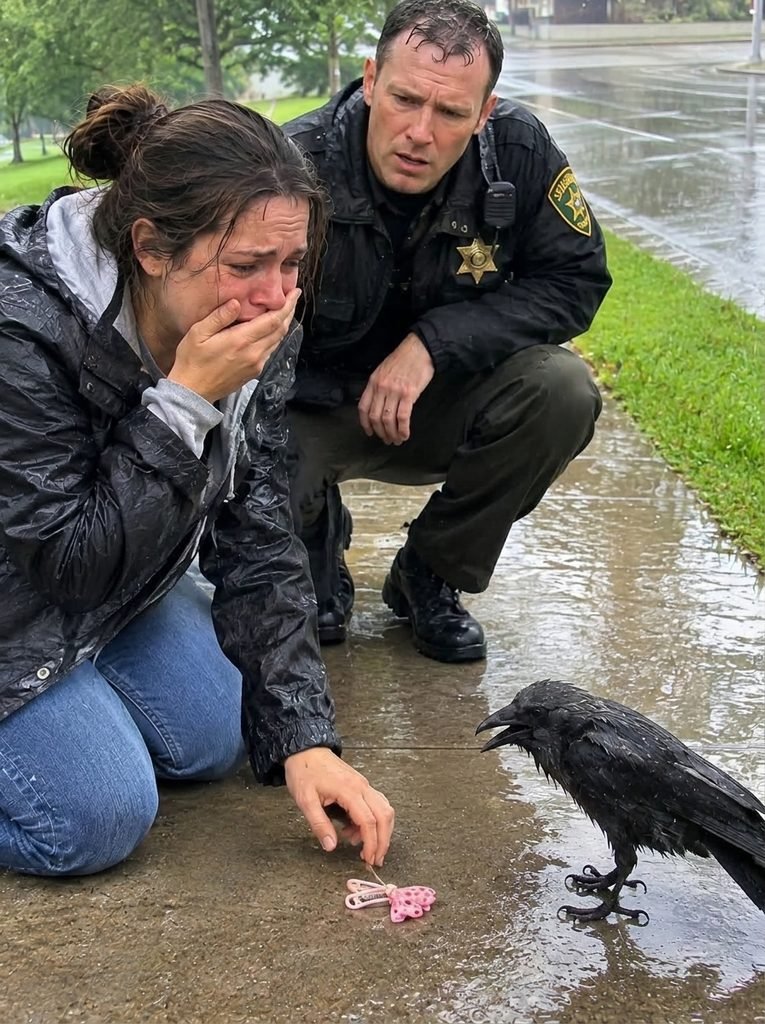
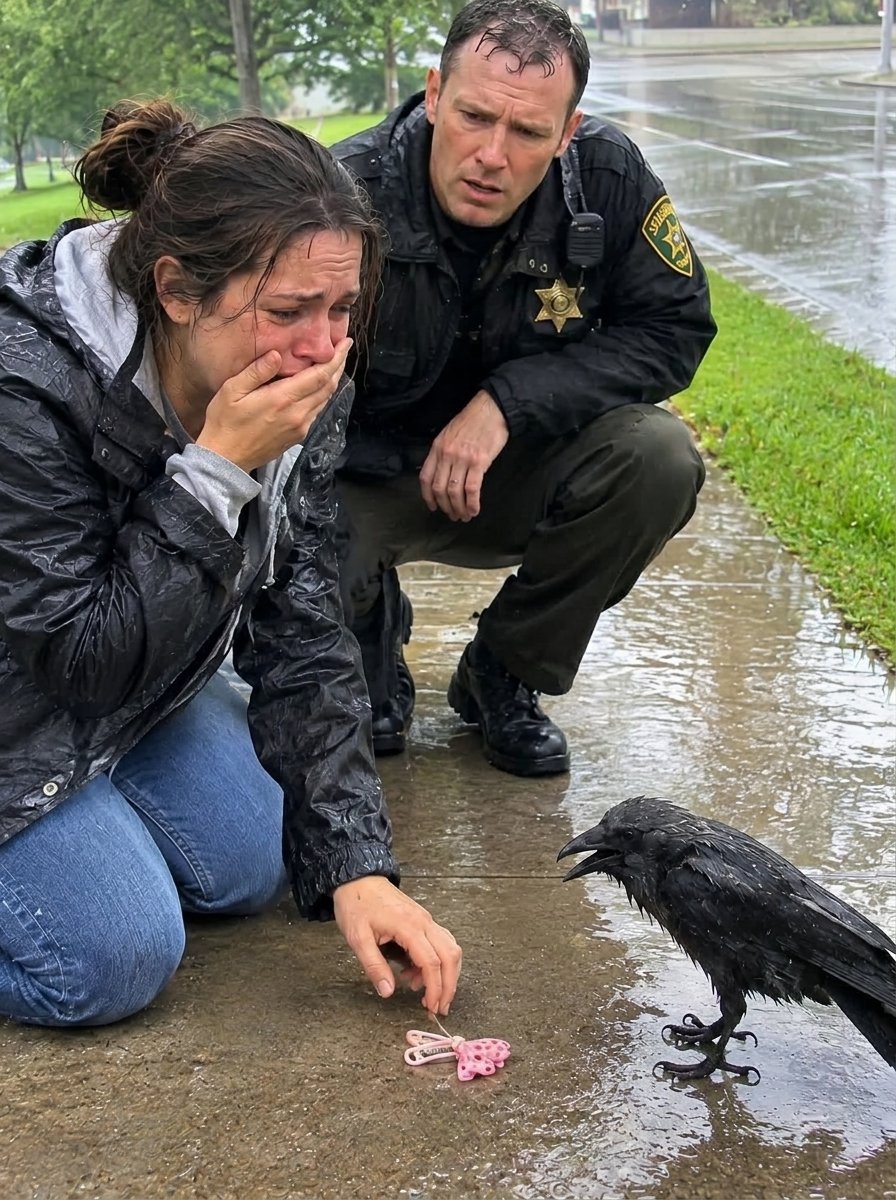
And then Edgar came down out of the gray sky, landed on the wet concrete two feet in front of me, and set that pink butterfly clip down by my shoe.
He looked up at me. He made a sound I’d never heard him make before. Not his usual morning caw. Something lower and faster. Urgent.
Then he flew to the top of the fence post at the end of the driveway and turned around and looked at me again.
“That’s hers,” I said. I picked up the clip with shaking fingers. “That’s Birdie’s. She was wearing this. He has her clip.”
The sheriff’s deputy standing beside me was a big man with a gray mustache and a rain cover on his hat. Deputy Ray Hollis. He’d been patient with me for three hours. He’d been kind. But I saw the look he gave the volunteer next to him.
“Ma’am,” he said gently, “birds pick up shiny things. She probably dropped it in the yard this morning.”
“No. She was wearing it when she went outside. I put it in her hair myself.” I held it up. “This is from wherever she is. He knows where she is.”
Edgar cawed from the fence post. Loud. Then he flew to the next post down the road. And turned around. And cawed again.
“He wants us to follow him.”
“Ma’am, I don’t think—”
I was already running.
But before I tell you what happened next, I need to tell you about the crow. And about the man who tried to take him away from us.Pages:
My name is Nora Whitaker. I’m thirty-six years old. I live at 418 Larkspur Lane in the Willow Bend subdivision in Meridian, Idaho, with my daughter, Birdie. Her real name is Bridget, after my grandmother, but she’s been Birdie since the day she was born because she came out chirping instead of crying. The nurse said she’d never heard anything like it.
Birdie is six.
Her father, my husband Caleb, died three years ago. He drove a delivery truck for a produce company in Boise. One icy morning in January, a semi jackknifed on Interstate 84, and Caleb couldn’t stop in time. The state trooper who came to our apartment door said it was instant. He said it like that was supposed to help.
Birdie was three. She doesn’t remember much about her daddy. She remembers that he smelled like oranges. She remembers he used to whistle at the birds in the park, and they’d whistle back.
Caleb had a life insurance policy through his job. Two hundred and fifty thousand dollars. I didn’t even know about it until a woman from the company’s human resources office called me two weeks after the funeral and asked where I wanted the claim forms sent.
I sat at my kitchen table in that tiny apartment and stared at those forms for a long time. It felt wrong to fill them out. Like I was trading him for money.
But I had a three-year-old and a job doing medical billing for a pediatric clinic that paid me $3,900 a month. So I filled them out.
I used $85,000 of that payout as the down payment on the house on Larkspur Lane. It’s a gray two-story with white trim and a small backyard with a wooden fence and a gate that opens onto a walking path. Beyond the path there’s an open field, and beyond the field there’s an irrigation canal with a gravel trail along it.
I bought it because the backyard had a big old cottonwood tree. Caleb always said he wanted Birdie to grow up with a tree to climb.
The mortgage is $2,180 a month. The HOA dues are $95 a month. The rest of the insurance money went into a savings account at Idaho Central Credit Union and a college fund for Birdie that I don’t touch.
The first year in that house was hard. Birdie didn’t sleep. She’d wake up screaming for her daddy. She stopped talking to other kids at preschool. She’d sit by the back window for hours staring at nothing.
Then one morning in the spring, she was sitting by that window, and she said, “Mommy. There’s a bird with a broken foot.”Pages:
He was sitting on the back fence. A big black crow, glossy and blue-black in the sunlight, with one foot curled up under him like a fist. He was balancing on the other one. Every time the wind blew, he wobbled.
Birdie pressed both hands against the glass.
“He’s hurt, Mommy. Can we feed him?”
I didn’t know anything about crows. I looked it up on my phone. One website said they liked unsalted peanuts. I had a jar of peanuts in the pantry that Caleb used to eat while he watched football. I’d never been able to throw them out.
I gave Birdie a handful. We went out on the back porch together. She put them on the railing very carefully, one at a time, in a straight line.
Then we went back inside and waited.
It took him almost an hour. He hopped down off the fence, landed on the railing on his one good foot, and ate every single peanut. Then he looked through the window at Birdie.
She waved at him.
He bobbed his head.
Birdie laughed. A real laugh. The first one I’d heard from her in months.
“His name is Edgar,” she announced.
“Why Edgar?”
“Because he looks like an Edgar.”
I couldn’t argue with that.
Edgar came back the next morning. And the next. Every morning at seven-fifteen, right as Birdie was eating her cereal, he’d land on the back railing and wait. Birdie put out the peanuts herself. She talked to him the whole time. About preschool. About her stuffed animals. About her daddy.
After a few weeks, his foot healed. He started standing on both feet. But he kept coming.
And then, one morning in June, he left something on the railing.
A bottle cap. Shiny silver, from a root beer.
Birdie gasped like it was a diamond.
“He brought me a present, Mommy!”
I thought it was a coincidence. But two weeks later, there was a button on the railing. Small and blue, with four holes. Then a piece of green sea glass. Then a tiny brass key that didn’t fit anything. Then, in August, a single pearl earring.
I looked it up again. Crows do that sometimes, the internet said. They bring gifts to people who feed them.
Birdie kept every one of them in an old mason jar on her windowsill. She called it her treasure jar. Every night before bed, she’d take everything out and line it up on her blanket and tell me the story of each one.
She started sleeping through the night again.
She started talking to the other kids at school.
She started laughing.
I’m not saying a crow fixed my daughter’s broken heart. But I’m not saying he didn’t help, either.
Then, last September, I found the first letter taped to my front door.
It was on official Willow Bend Homeowners Association letterhead, with a little logo of a willow tree at the top.
NOTICE OF VIOLATION. Article 7, Section 4(c) of the Declaration of Covenants, Conditions, and Restrictions. Feeding of wild animals, including but not limited to birds, squirrels, and waterfowl, is prohibited on any lot within the community. Please cease and desist immediately. A fine of $100 has been assessed to your account.
It was signed by Harold Dennison, President, Board of Directors.
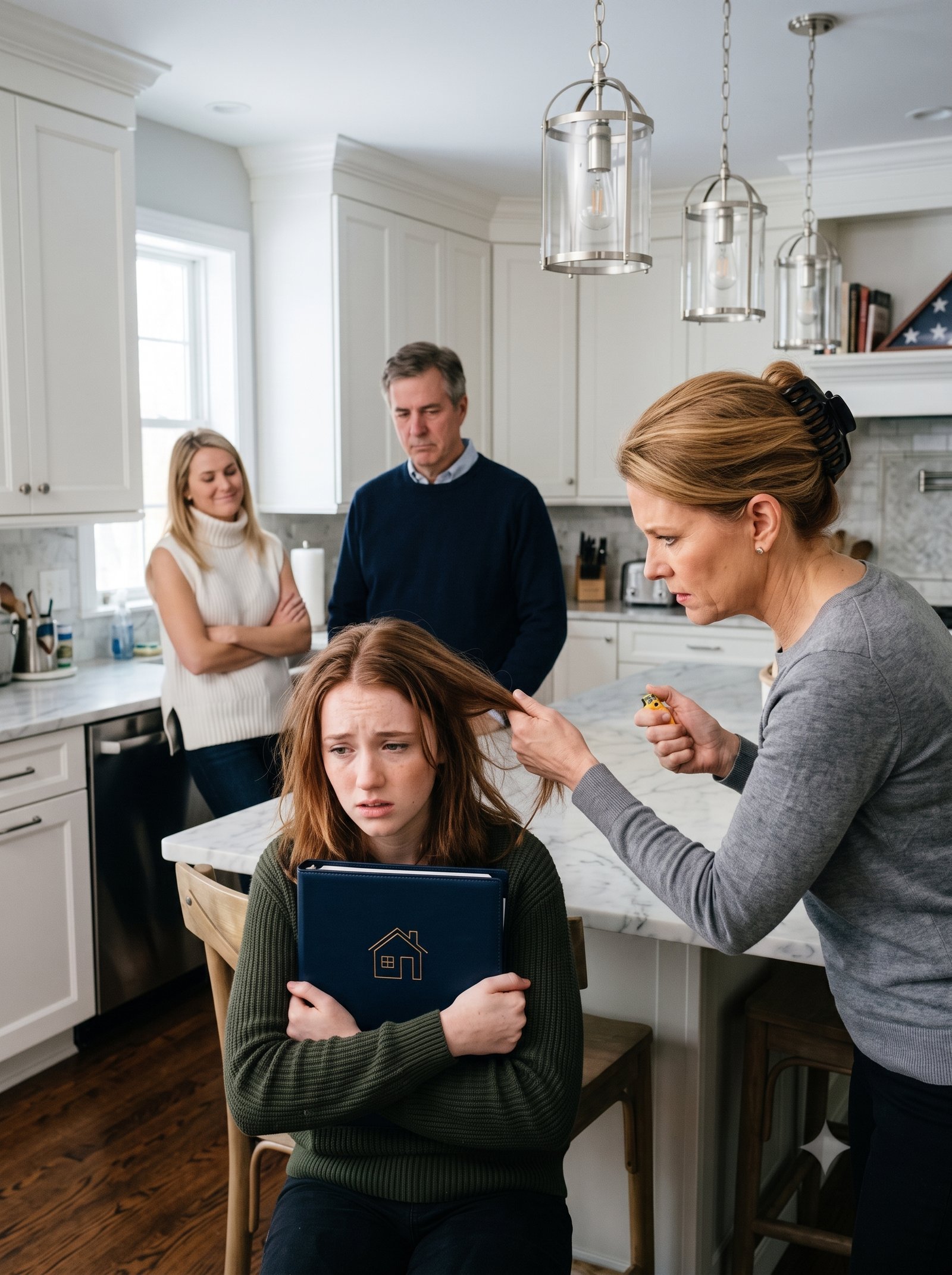
I knew who Harold Dennison was. Everybody in Willow Bend knew who Harold Dennison was. He lived at 402 Larkspur Lane, four houses down, in the biggest house on the street. He was sixty-eight, retired from thirty-five years as an insurance claims adjuster, and he walked the neighborhood every morning at six-thirty with a clipboard. He measured people’s grass. He photographed trash cans left out past the deadline. He once sent a violation notice to the Kowalskis because their Christmas lights were still up on January 16th.
His wife had died two years before Caleb. People said he’d gotten worse since then. Harder. Lonelier. Nobody ever said it to his face.
I went down to his house that afternoon to explain.
He opened the door wearing a cardigan and reading glasses. His living room behind him was spotless. Not a single thing out of place.
“Mr. Dennison, I got your notice. About the crow.”
“Mrs. Whitaker.” He nodded. “The rule is very clear.”
“I understand. But my daughter—she lost her father. The crow has really helped her. It’s just one bird. It’s just a few peanuts in the morning.”
“It’s never just one bird,” he said. “Crows are flock animals. You feed one, you get twenty. They carry disease. They raid trash cans. They leave droppings on cars. The Hendersons across the street have already complained twice about the noise.” He took off his reading glasses. “I’m sorry about your husband. I truly am. But I don’t make exceptions. If I make one for you, I have to make one for everybody.”
“He’s not hurting anybody.”
“Rules are rules, Mrs. Whitaker.” He started to close the door. “Please stop feeding the bird.”Pages:5
I tried. I really did.
I told Birdie we couldn’t put out peanuts anymore. I explained about the rules and the HOA and Mr. Dennison. She listened with her lip shaking. Then she asked me one question.
“Will Edgar think we don’t love him anymore?”
I didn’t have an answer for that.
Edgar kept coming. Every morning at seven-fifteen. He’d land on the railing and wait. He’d look in the window at Birdie. He’d make a soft clicking sound in his throat, like he was asking a question.
Birdie would stand at the glass with her hand pressed flat against it and cry.
After four days of that, I found her standing on a kitchen chair, reaching into the pantry for the jar of peanuts.
I didn’t stop her.
I know. I know. Rules are rules. But you try watching your six-year-old cry at a window every morning for a bird that thinks she abandoned him.
Two weeks later, the second letter came. This one wasn’t taped to the door. It came by certified mail, and I had to sign for it at the post office.
SECOND NOTICE OF CONTINUING VIOLATION. The Board has received photographic evidence that the violation of Article 7, Section 4(c) is ongoing. Pursuant to the Association’s fine schedule, a continuing fine of $50 per day has been assessed beginning September 22nd. Your current balance is $850.
There were three photographs stapled to the back. Grainy, taken from a distance. Birdie on the back porch in her pajamas, putting peanuts on the railing. Edgar beside her.
Somebody had stood on the walking path behind my fence and taken pictures of my daughter.
I sat down on the curb outside the post office and couldn’t breathe for a while.
The third letter came in October. It wasn’t from Harold Dennison. It was from a law firm in Boise. Pell & Associates, Attorneys for the Willow Bend Homeowners Association.
It said my account balance was now $2,850 in fines, plus $750 in attorney’s fees for the Association’s “collection efforts,” for a total of $3,600. It said that if the balance wasn’t paid within thirty days, the Board would “consider all remedies available under the Declaration and Idaho law,” including recording a lien against my property at 418 Larkspur Lane.
A lien. On my house. The house I’d bought with my husband’s life insurance money. The house with the cottonwood tree.
Over a crow and a jar of peanuts
I did the math at my kitchen table that night after Birdie went to bed. That’s what I do when I’m scared. I make columns.
I had $14,200 left in my savings account. That was supposed to be my emergency fund. The furnace was eleven years old. The roof was going to need work in a couple of years. Birdie needed new glasses. I’d been putting money aside for all of it.
$3,600 would take a quarter of it. And the fines were still going up. Fifty dollars every day the crow came back.
I called a lawyer from the Idaho State Bar referral line. He listened for five minutes and told me a consultation would cost $250 an hour. He said HOA disputes “can get expensive quickly” and that most people just paid.
I called the property management company the HOA used, Summit Community Management. I left four voicemails. Nobody called back.
I wrote a long, polite letter to the Board, explaining about Caleb, and Birdie, and the crow, and asking for a hearing. I hand-delivered a copy to every board member’s mailbox.
I got one email back. From Harold Dennison.
The Board has reviewed your request and declines to waive the fines. The rule exists for the benefit of the entire community. Please remit payment to Pell & Associates.
That was it. Two sentences.
I sat at the table with my columns and my calculator and cried until two in the morning. Then I made a decision.
The next morning, I sat Birdie down at the kitchen table.
“Sweetheart, we have to stop feeding Edgar. For real this time. If we don’t, the HOA might try to take our house.”
Her eyes got huge. “Our house? Daddy’s tree house?”
That’s what she called it. Daddy’s tree house. Because of the cottonwood.
“Yes, baby.”
She was quiet for a long time. She stared at the treasure jar on the windowsill. Then she got up, walked to the pantry, took out the jar of peanuts, and handed it to me.
“Hide it,” she said. “Hide it where I can’t find it. Because I’ll want to.”
My brave girl. I put it in the top of my bedroom closet behind the winter blankets.
That was on a Thursday.
Edgar came Friday morning at seven-fifteen. He sat on the railing. Birdie didn’t go to the window. She sat at the table with her back turned and ate her cereal with tears dripping into it.
Edgar waited for an hour. Then he flew away.
On Saturday, my daughter disappeared.
It was October 19th. The forecast said rain moving in by afternoon, heavy at times, temperatures dropping into the low forties overnight.
Around one o’clock, Birdie asked if she could play in the backyard before the rain started. She put on her purple rain boots and her yellow jacket. I clipped the pink butterfly into her hair, over her left ear, the way she liked it.
“Stay in the yard,” I told her. “Where I can see you.”
“I know, Mommy.”
I stood at the kitchen window and watched her for a while. She was sitting under the cottonwood tree, talking to her stuffed rabbit. Every once in a while, she’d look up at the sky. I knew who she was looking for.
At 1:20, my phone rang. It was a number I didn’t recognize. A Boise area code.
“Mrs. Whitaker? This is Janet from Summit Community Management. I’m returning your calls about the Willow Bend fines.”
Finally. I’d been waiting three weeks for that call.
I turned away from the window to grab a pen and a notepad off the counter. I sat down at the kitchen table. I told Janet everything. I read her the dates from my notepad. I asked her about the photographs, and who had taken them, and whether the Board had ever actually voted on the attorney’s fees.
Janet put me on hold twice. She said she’d have to “check with the Board President.” She said she’d “escalate the matter.”
The call lasted fourteen minutes. I know because I looked at the screen when I hung up. 1:34 p.m.
I got up and looked out the window.
The backyard was empty.
Her stuffed rabbit was lying under the cottonwood tree, face down in the grass.
And the back gate, the one that opens onto the walking path, was standing wide open, swinging a little in the wind.
I don’t remember running outside. I just remember being on the walking path screaming her name.
“Birdie! BIRDIE!”
The field behind the subdivision was empty. Tall brown grass, bending in the wind. Gray clouds pressing down low. Beyond the field, the canal, high and brown and fast with the fall irrigation runoff.
The canal.
Every parent in Willow Bend knows about the canal. Two summers ago, a teenager from another subdivision had gone in at a spot two miles down and nearly drowned. There’s a chain-link fence along part of it, but not all of it. Not near us.
I called 911 with my hands shaking so hard I dropped the phone in the grass twice.
The first deputy arrived in eight minutes. Then two more. Then a sergeant. Then a truck from Ada County Search and Rescue with volunteers in orange vests. Then a man with a bloodhound named Duchess.
By three o’clock, there were fifty people out there. Neighbors I’d only ever waved at, walking in lines through the field, arms spread wide, calling her name. The Hendersons from across the street. The Kowalskis with their teenage sons. The young couple from the end of the street who’d just moved in and whose names I didn’t even know yet.
Harold Dennison was out there too.
I saw him at the edge of the field in a rain jacket, with a flashlight, walking slow and steady along the fence line. He didn’t come near me. He didn’t say anything. He just walked and called her name, over and over, in a hoarse, cracked voice.
Duchess the bloodhound took Birdie’s scent from her pillowcase. She tracked it out the back gate and across the field to the canal trail. And then, at the edge of the canal, she lost it. She circled and circled and whined and sat down.
The man holding her leash looked at Deputy Hollis. Deputy Hollis looked at the water.
Nobody looked at me.
“No,” I said. “No. She knows not to go near the water. She knows.”
At 3:40, the rain started.
At 4:15, they called in the dive team.
At 4:30, a deputy walked me back to my driveway and told me to wait there in case Birdie came home on her own. I knew what that meant. It meant they didn’t want me watching while the divers went into the canal.
So I stood in my driveway in the rain, holding her purple stuffed rabbit against my chest, staring at the gray sky.
And at 4:52, Edgar came down out of the clouds with my daughter’s butterfly clip.
“Ma’am, I don’t think—”
I was already running.
Deputy Hollis swore under his breath and came after me. So did two of the search-and-rescue volunteers who’d been standing by the truck, a young man and an older woman, both with big yellow flashlights.
Edgar flew from post to post ahead of us. Fence post, mailbox, streetlight, fence post. Every time we got close, he flew to the next one. Every time, he turned around and looked back to make sure we were following. Every time, he called. That same low, fast, urgent sound.
“He’s leading us,” the young volunteer said, breathing hard behind me. “I swear to God, Deputy, he’s leading us.”
“I see it,” Hollis said. He didn’t sound like he was humoring me anymore.
Edgar led us out past the end of Larkspur Lane, onto the canal path. He flew straight past the spot where Duchess had lost the scent. Past the place where the divers were suiting up. A quarter mile further down the gravel trail, then another quarter mile, way past where the searchers had walked.
Then he turned off the path.
He flew down a steep embankment on the far side of the trail, away from the canal, into a gully choked with Russian olive trees and blackberry brambles and tall wet weeds. There was no trail down there. It was outside the walking paths. Nobody had searched it, because there was no reason for a six-year-old to go down there.
I went down that embankment half sliding, half falling. Mud up to my knees. Blackberry thorns tearing at my jeans and my hands. I didn’t feel any of it.
At the bottom of the gully, there was a big concrete drainage pipe. A culvert. It ran under the road above, carrying runoff from the subdivision. The opening was round and dark and taller than a child. Taller than me, almost, if I bent over.
Water was trickling out of it. Brown water. Getting faster.
Edgar landed on top of the concrete, right over the opening.
He cawed and cawed and wouldn’t stop.
I dropped to my knees in the mud at the mouth of the pipe and shined my phone’s flashlight inside. Nothing but darkness and wet concrete and the sound of running water echoing back at me.
“Birdie? BIRDIE!”
Nothing.
Then, from somewhere deep inside the pipe, a tiny voice.
“Mommy?”Pages:
I made a sound I didn’t know a human being could make.
“Baby! Baby, I’m here! Mommy’s here! Are you hurt?”
“I’m cold.” Her voice was small and shaking and far away. “I’m really cold, Mommy. And there’s water.”
Deputy Hollis was already on his radio. “Found her! We found her! Culvert under Ten Mile Road, south side, about half a mile east of the subdivision. She’s alive. Get me EMS down here now. And get me somebody small.”
Water was running along the bottom of the culvert. I could see it in my flashlight beam, rushing over the concrete. The rain was getting heavier. And the water was rising. I watched it creep up the sides of the pipe while I knelt there.
“How far in is she?” Hollis asked.
“I can’t tell. Birdie, honey, can you see my light?”
“A little bit,” she said. “Way far away.”
The pipe was too narrow for Deputy Hollis. He’s six-foot-three with shoulders like a refrigerator. He tried. He got halfway into the opening and got stuck.
I started to crawl in myself. The older volunteer grabbed my arm.
“Ma’am, you’re shaking too hard. If you get stuck, we’ve got two people to get out.”
The young volunteer was already pulling off his orange vest and his rain jacket. He was maybe twenty-two, skinny as a fence rail, with wet blond hair plastered to his forehead.
“I’ve got it,” he said. “I’m the smallest one here.”
His name was Arlen Pike. I found that out later. He was a junior at Boise State studying to be a paramedic. He’d been a search-and-rescue volunteer for eight months. This was his first real find.
He got down on his stomach in the brown water. He put his flashlight between his teeth. He crawled into that pipe on his elbows, into the dark, and disappeared.
I knelt in the mud at the opening and held onto the concrete and prayed out loud. I didn’t even know what I was saying. Edgar sat on top of the pipe above my head, perfectly still now. Not making a sound. Watching the darkness, just like me.
I could hear Arlen’s voice echoing in the pipe. Talking low and calm.
“Hey, Birdie. My name’s Arlen. Your mom sent me. I really like your boots.”
The longest two minutes of my life.
Then I heard scraping. Splashing. Arlen’s voice getting closer.
“Okay. Okay, here we go. Hold on to my neck. Good job. You’re doing so good.”
He backed out of that pipe on his knees, soaking wet, covered in mud.
Holding my daughter.
She was soaked to the bone and shivering so hard her teeth were clicking. She was covered in mud from her hair to her one remaining purple rain boot. The other foot was bare and scraped. Her lips were blue. Her yellow jacket was dark brown with water.
But she was alive.
She was alive.
I grabbed her out of Arlen’s arms and pulled her inside my jacket against my chest and wrapped myself around her. She was so cold. Like holding a bag of ice. I rocked her and kissed her muddy hair and cried, and she cried, and I don’t know how long we sat there in the mud at the bottom of that gully.
“I’m sorry, Mommy,” she kept saying. “I’m sorry. I’m sorry.”
“Shhh. Shhh. You’re okay. You’re okay. I’ve got you.”
The paramedics came down the embankment with a rescue basket. They wrapped Birdie in a silver blanket and strapped her in, and four of them carried her up that muddy slope while I held her hand the whole way.
At the top of the embankment, about thirty people had gathered on the canal path. Searchers. Neighbors. Volunteers. When they saw the basket come up over the edge with Birdie inside, wrapped in silver, somebody started clapping. Then everybody was clapping and crying in the rain.
At the very back of the crowd, I saw Harold Dennison.
He was standing alone under a streetlight with his flashlight hanging at his side. His face was wet. I couldn’t tell if it was rain.
When I looked at him, he turned and walked away.
Birdie told us the whole story later, at the hospital, wrapped in three heated blankets with a cup of warm apple juice.
She’d been playing under the cottonwood tree when she saw a little gray kitten on the walking path behind the fence. It was all by itself. It was crying. She thought it was lost.
“It needed help, Mommy,” she said. “Like Edgar needed help.”
She opened the back gate. Just to get the kitten. But the kitten ran away from her. Across the field, along the canal trail, and down into the gully. She followed it. Down the embankment. Into the brambles. Then the kitten ran into the big pipe.
So she crawled in after it to rescue it.
“It went way in,” she said. “And I kept going. And then it was too dark and I couldn’t see anything and I didn’t know which way was out.”
She’d found a little ledge of dry concrete inside, a lip where two sections of pipe met. She climbed up on it and sat there, hugging her knees, crying, for three hours.
“I heard everybody yelling my name,” she whispered. “But I was too scared to yell back. I thought I’d be in trouble for going out the gate.”
Her voice got very quiet.
“Edgar kept flying to the end of the pipe. I could see him in the light. He was talking to me. He kept talking to me the whole time so I wouldn’t be scared.”
“He took your butterfly clip,” I said, and I held it up. The little pink plastic butterfly. One of its wings was snapped off.
Birdie’s eyes went wide.
“It fell off when I was crawling,” she said. “In the pipe, near the front, where it was still a little bit light. And Edgar came down and picked it up in his beak. I thought he was stealing it.”
She looked at the clip for a long time.
He wasn’t stealing it.
He was bringing it home.
He’d flown it half a mile back to our house, past fifty searchers and a bloodhound and a dive team, and dropped it at my feet. Because he knew I’d recognize it. Because he knew I’d follow him.
The paramedics treated Birdie for mild hypothermia. Her core temperature was 94.6 degrees when they brought her into the emergency room at St. Luke’s Meridian. The doctor, a tired, kind woman named Dr. Sarah Tran, said that another hour in that pipe, with the water rising and the temperature dropping, and it would have been a very different conversation.
“You got lucky,” she said.
“It wasn’t luck,” I said. “It was a crow.”
She looked at me like everybody looks at me when I say that. Then she smiled.
“Well. Whatever it was, I’m glad.”
Birdie spent one night in the pediatric unit. They kept her on warm fluids and checked her every two hours. I didn’t sleep. I sat in the chair beside her bed and held her hand and watched her breathe.
In the morning, she was pink and warm and hungry and asking for pancakes. A volunteer from the hospital gift shop came by with a cart, and Birdie picked out a stuffed black crow with shiny button eyes.
“His name is Edgar Junior,” she announced.
The hospital bill came three weeks later. $6,840 for the ambulance, the emergency room, and the overnight stay. My health insurance through the pediatric clinic covered most of it. My share was $1,500, my whole deductible.
I paid it the same day. I didn’t even do the columns first.
Best money I ever spent.
Deputy Ray Hollis came to our house the next afternoon.
He stood on my front porch in his uniform with his hat in his hands and a stuffed animal under his arm. It was a little gray kitten. He’d found it at the gift shop at the Boise Towne Square mall on his way over.
“For the young lady,” he said, a little embarrassed. “Since the real one ran off.”
They’d found the real kitten, by the way. A volunteer pulled it out of the other end of the culvert the next morning. It belonged to a family two streets over. It was fine.
Birdie took the stuffed kitten and hugged Deputy Hollis around the knees. He patted her head like he wasn’t sure how.
Then he looked at me.
“Mrs. Whitaker. I owe you an apology. When you told me that bird knew where she was, I thought you were losing your mind. I thought it was grief talking.”
“I would’ve thought the same thing,” I said.
“Twenty-two years on the job,” he said, shaking his head. “I’ve worked a lot of missing kid cases. I’ve never seen anything like that. That bird found her when our dogs couldn’t. When our helicopter couldn’t. When fifty people couldn’t.”
He looked out at my backyard. Edgar was sitting on the top of the cottonwood tree, preening his feathers like nothing had happened.
“I wrote it in my report,” Hollis said. “Exactly how it happened. My sergeant’s going to think I’ve lost it.”
The local news ran the story that night. KTVB Channel 7 sent a reporter and a camera crew to our house. They filmed Edgar on the back railing. They filmed Birdie holding up her treasure jar. They interviewed Arlen Pike, who blushed and kept saying he didn’t do anything special.
Two days later, a national morning show called. They flew out a producer from New York. The segment aired on a Tuesday. By Wednesday, my phone had over four hundred messages on it from people all over the country.
Then a woman called me from the University of Idaho. Dr. Lena Ruiz. She studies bird behavior. She’d spent fifteen years researching crows.
“Mrs. Whitaker, I hope you don’t mind me calling. I saw your story, and I just had to talk to you.”
She told me that crows are among the smartest animals on the planet. She said they can recognize individual human faces and remember them for years. They remember people who are cruel to them. And they remember people who are kind.
“There’s research showing crows teach each other which humans are safe,” she said. “They pass it down to their young. They hold grudges, and they hold gratitude. What your crow did, bringing an object he knew belonged to your daughter to someone he knew would understand it, that’s remarkable. But I’m not sure it’s surprising.”
“What do you mean?”
“Your daughter fed him when he was hurt. She talked to him every day. She left him food when he couldn’t find his own.” Dr. Ruiz paused. “Your crow knew your daughter, Mrs. Whitaker. And he knew you.”
Harold Dennison came to my front door that Friday.
I almost didn’t open it. I watched him through the peephole for a long time. He was standing on my welcome mat in his cardigan, looking older than I remembered. Smaller. He had his hat in his hands, turning it around and around by the brim.
I opened the door.
“Mrs. Whitaker,” he said. He cleared his throat. “May I have five minutes?”
I didn’t invite him in. I stepped out onto the porch and pulled the door closed behind me. Birdie was inside watching cartoons.
He stood there for a long moment without saying anything. He looked at the cottonwood tree over my roof. He looked at his shoes.
“I owe you an apology,” he finally said. “A real one. Not the kind I usually give.”
I waited.
“I called Pell & Associates on Monday morning. I told them the Association is withdrawing all collection efforts against your account. The fines are canceled. All of them. The attorney’s fees too. Every dollar. There will be no lien. There was never going to be a lien, honestly. That was the lawyer’s language. I should never have let him send it.”
I stared at him.
“There’s something else,” he said. His voice got rough. “That culvert. Under Ten Mile Road. Four years ago, a resident at a board meeting asked us to put a locked grate over the opening. She said it was dangerous. That a child could crawl in there. The estimate was $4,200.”
He swallowed hard.
“I voted it down. I said it was a waste of the reserve fund. I said nobody’s child would ever go down in that gully. I said it wasn’t the Association’s problem.”
He looked up at me, and his eyes were wet.
“I stood under that streetlight on Saturday night and watched them carry your little girl up that hill in a basket, and all I could think about was that $4,200. And about how I spent three months chasing her and her crow, taking pictures over your fence like some kind of—” He stopped. “I took those pictures, Mrs. Whitaker. Not the Hendersons. Me. I stood on the walking path and photographed a grieving child feeding a bird.”
I didn’t say anything. I didn’t trust my voice.
“My wife used to feed the sparrows,” he said quietly. “Every winter. She’d put out seed on the back fence. Back before there was an HOA. Before there were rules about it. After she passed, I couldn’t stand to look at them. The birds. I guess I didn’t want anybody else to have what I didn’t have anymore.”
He held out a small brown paper bag.
I took it. I opened it.
Unsalted peanuts.
“For the bird,” he said. “From me.”
The next Willow Bend HOA board meeting was on the second Tuesday in November, in the community room at the clubhouse. It’s usually about twelve people and a plate of store-bought cookies.
That night, there were ninety-three. I counted. People were standing along the walls. The Kowalskis brought folding chairs from home. Deputy Hollis came in uniform and stood in the back. Arlen Pike came with his mother. Dr. Lena Ruiz drove two hours from the university just to be there.
Harold Dennison called the meeting to order. His hands were shaking a little on the gavel.
“First item of new business,” he said. “A motion to authorize emergency spending from the Association’s reserve fund for the installation of a locked steel safety grate over the drainage culvert under Ten Mile Road. The estimate from Treasure Valley Fabrication is $5,100. Is there a second?”
Every hand in the room went up. Not just the board members. Everybody.
Harold almost smiled. “I’ll take that as a second. All in favor?”
The vote was unanimous. Five to nothing. The grate was installed eleven days later. It has a big padlock on it, and a sign that says DANGER: KEEP OUT in red letters, and underneath, in smaller letters, somebody added: Thank you, Edgar.
“Second item of new business,” Harold said. He looked down at his papers. Then he looked straight at me in the third row. “A motion to amend Article 7, Section 4(c) of the Declaration of Covenants, Conditions, and Restrictions. Specifically, to strike the words ‘including but not limited to birds.’”
Somebody in the back started laughing. Then somebody started clapping.
“The new language,” Harold went on, raising his voice over the noise, “will read as follows. ‘Residents may feed wild birds on their own lots, provided that feeders and food are maintained in a clean and sanitary condition.’ Is there a second?”
Ninety-three hands again.
“All in favor?”
Five to nothing.
Feeding wild birds is now allowed in Willow Bend.
After the meeting, while people were milling around eating cookies, Harold Dennison came over to Birdie and me. He crouched down slowly, his knees cracking, until he was eye level with her.
“Miss Birdie,” he said. “I owe you an apology too. I’m very sorry I tried to take away your friend.”
Birdie studied his face for a long time. Very serious. The way she does.
Then she reached into her coat pocket and pulled something out and put it in his hand.
It was a silver root beer bottle cap. The very first gift Edgar ever left her.
“You can have one,” she said. “So you can start a jar too.”
Harold Dennison looked down at that bottle cap in his palm.
And then that stiff, lonely, clipboard-carrying old man sat down right there on the clubhouse floor and cried.
Edgar still comes every morning.
Seven-fifteen. Right on time. Rain or snow or sunshine. He lands on the back railing and clicks his beak and waits.
Birdie leaves the peanuts herself now. She doesn’t need me to help anymore. She lines them up in a perfectly straight row on the railing, one at a time, and then she sits on the top porch step in her pajamas and talks to him while he eats. About first grade. About her friend Maya. About the stuffed crow named Edgar Junior and the stuffed kitten that doesn’t have a name yet because she can’t decide.
Sometimes she talks to him about her daddy.
Edgar listens. He always listens.
Some mornings now, there are two crows on the railing. Edgar brought a friend. Dr. Ruiz says it’s probably his mate. Birdie named her Lenore.
And some mornings, when I look out the kitchen window, I can see four houses down to the back fence of 402 Larkspur Lane. There’s a brand-new wooden bird feeder hanging there now. Full of seed. Sparrows crowding all over it.
And standing next to it in his cardigan, with a cup of coffee and no clipboard, is Harold Dennison. Just watching them.
Last week, on a cold Tuesday morning, Edgar left one more gift on the porch railing.
Birdie saw it first. She came running into the kitchen in her socks, holding it up in her fist, so excited she could barely talk.
“Mommy! Mommy, look!”
She opened her hand.
It was a tiny pink plastic butterfly wing. The piece that had broken off her hair clip in the dark, inside the pipe, the day she got lost.
Somehow, Edgar had gone back for it. Back down into that gully, back to the culvert, maybe before the grate went up, maybe slipping through the bars after. I’ll never know how. I’ll never know when.
He’d been holding onto it this whole time. Waiting to bring it home.
Birdie carried it upstairs very carefully in both hands. She took the mason jar down from her windowsill and set it on her bed. She took out every treasure, one by one, and lined them up on her blanket. The bottle caps. The blue button. The green sea glass. The tiny brass key. The pearl earring. And the little pink butterfly clip with one wing missing.
Then she held the broken wing up next to the clip, fitting them together.
She put them both in the jar. Right in the middle. Right where she could see them.
Then she screwed the lid back on and set the jar on the windowsill, where the morning sun came through the glass and lit everything up gold.
She stood back and looked at it with her hands on her hips.
“Now it’s complete,” she said.
Outside, on the back railing, a big black crow bobbed his head once and flew up into the cottonwood tree.Pages: