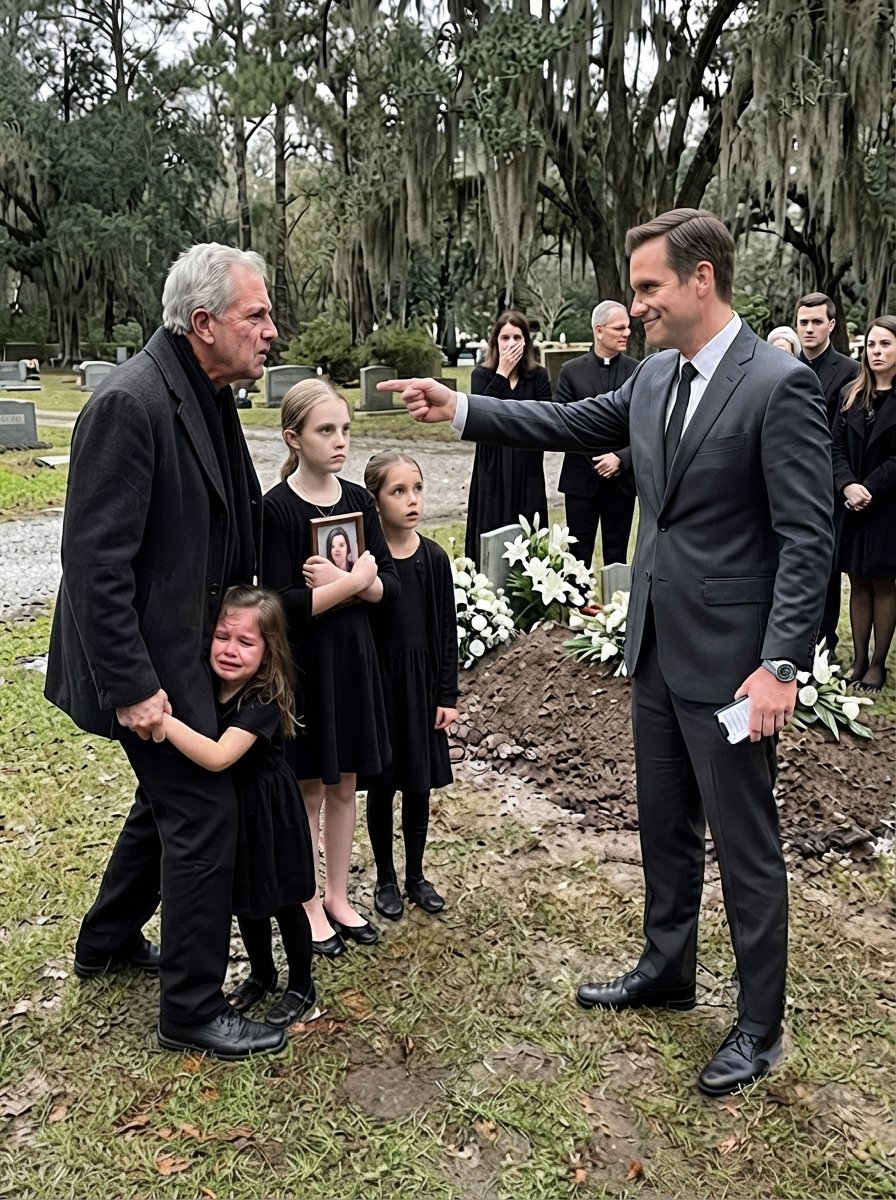
They Told Me I Was No Longer Family. They Forgot That I Owned the House.
By Friday night, my cellphone showed 99 missed calls.
Ninety-nine desperate attempts to reach me from the same family that had informed me, less than two days earlier, that I was no longer welcome in their lives.
My oldest son had sent the message.
My daughter-in-law had approved it.
My younger son had remained silent.
And my own sister had watched the entire thing happen without lifting a finger to defend me.
They thought I would cry, apologize, and beg for another chance to sit at their Christmas table.
Instead, I replied with one calm sentence.
**”Message received and understood. Enjoy your last family dinner.”**
Then I called my attorney.
What happened afterward destroyed the comfortable little world my children had built around themselves.
But the most heartbreaking discovery wasn’t that my family wanted my money while refusing to acknowledge my existence.
It was finding out who had carefully arranged the entire betrayal.
My name is Evelyn Gable.
I’m seventy-one years old, and until that December, I believed the greatest tragedy of my life had been losing my husband.
I was wrong.
Walter Gable died six years ago, after forty-three years of marriage.
We weren’t wealthy when we met.
He drove a battered pickup truck, wore work boots with holes in the soles, and worked twelve-hour shifts at a cabinetmaking shop outside Columbus, Ohio.
I worked as a receptionist at a dental office.
We rented a tiny apartment where the kitchen floor sloped so badly that oranges rolled toward the refrigerator.
But Walter had a dream.
He wanted to build furniture that people would pass down to their grandchildren.
When he finally opened Gable Woodworks, he had three employees, a garage full of secondhand equipment, and a wife who balanced invoices at the kitchen table after putting two little boys to bed.
Those boys were Kenneth and Mason.
Kenneth, our oldest, was stubborn from the moment he learned to walk.
Mason was quieter, the kind of child who could spend an entire afternoon dismantling a broken radio just to understand how it worked.
Walter adored them both.
He worked himself nearly to exhaustion so they would have opportunities he never had.
And I supported every sacrifice because I believed we were building something greater than a business.
**We were building a family that would always take care of one another.**
By the time Walter died, Gable Woodworks employed forty-two people.
We owned a comfortable home, had money saved for retirement, and controlled several properties through the Gable Family Living Trust.
Kenneth was president of the company.
Mason supervised payroll and internal financial systems.
My sister Gertrude, who had helped with the office administration for years, still handled certain bookkeeping responsibilities.
Walter had arranged things carefully.
The trust held our family home, the suburban house where Kenneth and Brenda lived, and the San Diego beach property we had helped them acquire.
The trust also controlled the majority of the voting shares in Gable Woodworks.
When Walter died, I became the sole trustee.
I never made a big announcement about it.
I didn’t want my sons worrying about property or inheritance.
I wanted them to live their lives.
Perhaps that was my first mistake.
I had confused generosity with love.
And slowly, my family began confusing generosity with entitlement.
It started with little things.
Brenda stopped asking me to help prepare holiday dinners.
Then she began hosting celebrations without telling me.
When I asked why I hadn’t been invited to Kenneth’s birthday party, she smiled sweetly.
“Oh, Evelyn, we thought the noise might be too much for you.”
I was sixty-eight, not ninety-eight.
But I smiled anyway.
Then came the photographs.
Family reunions.
Pool parties.
Weekend trips.
A Fourth of July barbecue where everyone wore matching red, white, and blue shirts.
Everyone except me.
I hadn’t even known about it.
At my granddaughter Nora’s graduation, there was an entire family photograph taken beneath the school banner.
I discovered it two days later on Facebook.
When I called Kenneth, he sounded irritated.
“Mom, you know how these things get. We thought you wouldn’t want to sit through the crowds.”
“But I wanted to see my granddaughter graduate.”
“You’re making this bigger than it is.”
That became his favorite sentence.
Whenever I expressed hurt, I was making things bigger than they were.
Whenever I asked a question, I was being controlling.
Whenever I wanted to see my family, I was interfering.
Gertrude told me to ignore it.
“Young people need their space, Evelyn.”
“But I’m their mother.”
“And mothers need to learn when to step aside.”
I remember staring at her.
We had shared a bedroom growing up. She had held my hand after Walter’s funeral. She knew exactly what my children meant to me.
I expected kindness from her.
Instead, she changed the subject.
By the beginning of December, I had stopped asking why I wasn’t invited to things.
I simply waited.
Then, on a bitter Thursday afternoon, the answer arrived.
I was making chicken soup for my neighbor Ruth when my cellphone buzzed beside the stove.
The clock showed 2:30.
A message appeared in the family group chat.
“Mom, we’ve discussed this as a family. It’s time for us to cut ties. Please don’t make plans to come to holiday dinners anymore. This is better for everyone.”
I read it three times.
My hands began trembling.
There are moments when grief doesn’t arrive as tears.
Sometimes it arrives as silence.
A terrible, hollow silence in which you can hear the refrigerator humming and the wind rattling against the window.
That was how I felt.
My son had just told me I no longer belonged to my own family.
Then Brenda reacted with a thumbs-up.
Mason read the message but said nothing.
Gertrude said nothing.
Nobody defended me.
I sat at the kitchen table, staring at the words.
I remembered Kenneth as a little boy, running down the stairs on Christmas morning in his dinosaur pajamas.
I remembered Mason crawling beneath the Christmas tree, trying to guess which presents belonged to him.
I remembered Walter carving the turkey while pretending he couldn’t find the carving knife.
Those memories were so vivid I could almost hear their voices.
And now I was being told not to come anymore.
I wanted to call Kenneth.
I wanted to ask what terrible thing I had done.
Then I remembered something Walter had taught me.
**”When people show you who they are, Evelyn, don’t argue with the evidence.”**
I took a screenshot.
Then I scrolled through the previous messages, saving the family photographs and conversations I had tried so hard to ignore.
The San Diego vacation.
The birthdays.
The graduation.
All the celebrations that had continued perfectly well without me.
I looked at a photograph of Kenneth and Brenda standing outside the beach house.
The same beach house Walter and I had helped purchase.
I thought about Brenda’s car, which I had co-signed for when her credit was poor.
I thought about Kenneth’s job at Walter’s company.
And the lovely suburban house where they lived while paying far less than they would have paid for a comparable rental.
Then I realized something.
**My family had spent years separating me from their lives without separating themselves from my financial support.**
I set down my phone.
Walked into the hallway.
And stared at the photograph of Walter hanging above the old wooden telephone table.
“You always told me I was too soft,” I whispered.
His familiar smile looked back at me.
For the first time that afternoon, I felt something besides sadness.
I felt clarity.
I picked up our old rotary telephone and dialed Thomas Abernathy.
He had been Walter’s attorney for nearly twenty years.
“Thomas Abernathy speaking.”
“Thomas, it’s Evelyn.”
“Evelyn. Is everything all right?”
“I think it’s time we discussed the family trust.”
He went quiet.
Then he said, “I’ve been wondering when you would call.”
I frowned.
“What does that mean?”
“There are some matters I’ve wanted to review with you. I left messages last week.”
I remembered the calls.
I’d assumed they concerned routine paperwork.
“Can you come to my house?”
“Of course.”
“Bring the property deeds.”
“All three?”
“Every one of them.”
“I can be there in thirty minutes.”
After hanging up, I climbed the stairs.
I brushed my silver hair into a low bun and changed into my favorite blue cardigan.
Then I looked at myself in the mirror.
I wasn’t a frightening woman.
I was somebody’s mother.
Somebody’s grandmother.
A widow who loved tending roses and baking apple pies.
But I was also the woman who had helped her husband build a company from nothing.
And apparently, my children had forgotten that part.
My phone started ringing.
Kenneth.
I ignored it.
He called again.
Then Brenda called.
Then Kenneth called from his office number.
I opened the family chat one final time.
**”Message received and understood. Enjoy your last family dinner.”**
I sent it.
Then I left the group.
The calls intensified almost immediately.
“Mom, what does that mean?”
“Answer your phone.”
“Stop being dramatic.”
“Brenda is crying. Are you happy now?”
I actually laughed at that last one.
Brenda was crying.
The same woman who had publicly approved of cutting me off was distressed because I hadn’t responded according to her expectations.
I saved every message.
Then I put my phone on silent.
Thomas arrived carrying his familiar leather briefcase.
Ruth had come to collect her soup and let him inside.
“Is everything okay, Evelyn?” she asked.
“It will be, dear.”
She studied my face for a moment.
Ruth had been my neighbor for eighteen years.
She knew me well enough not to ask twice.
“Then I’ll leave you two to your business.”
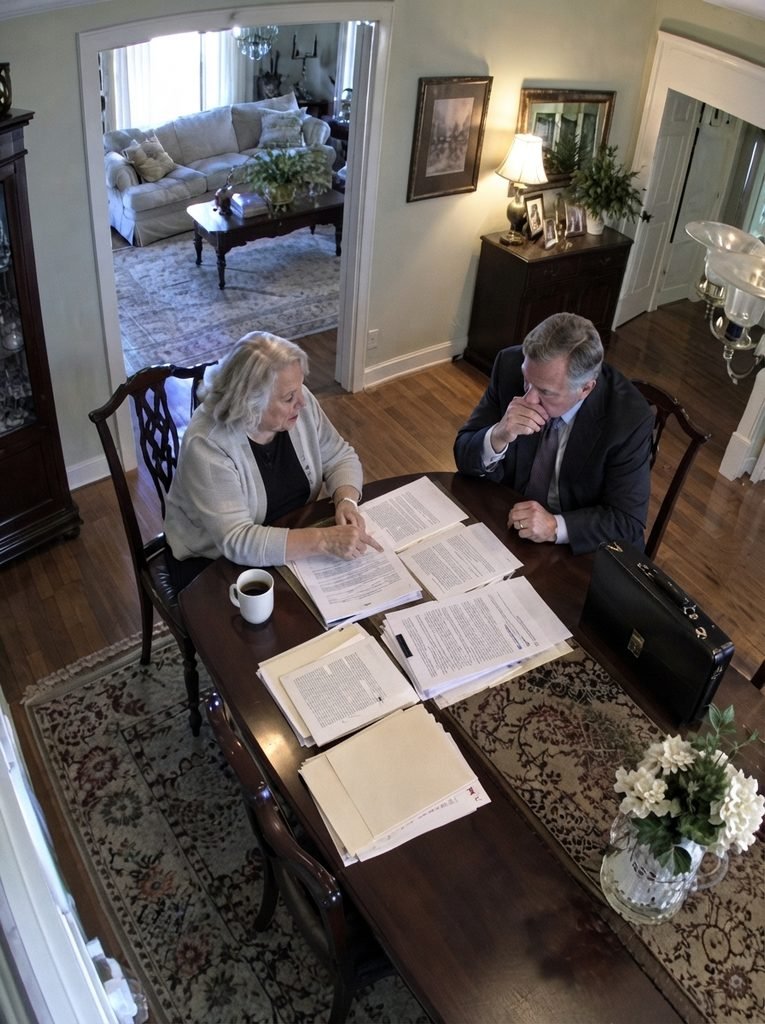
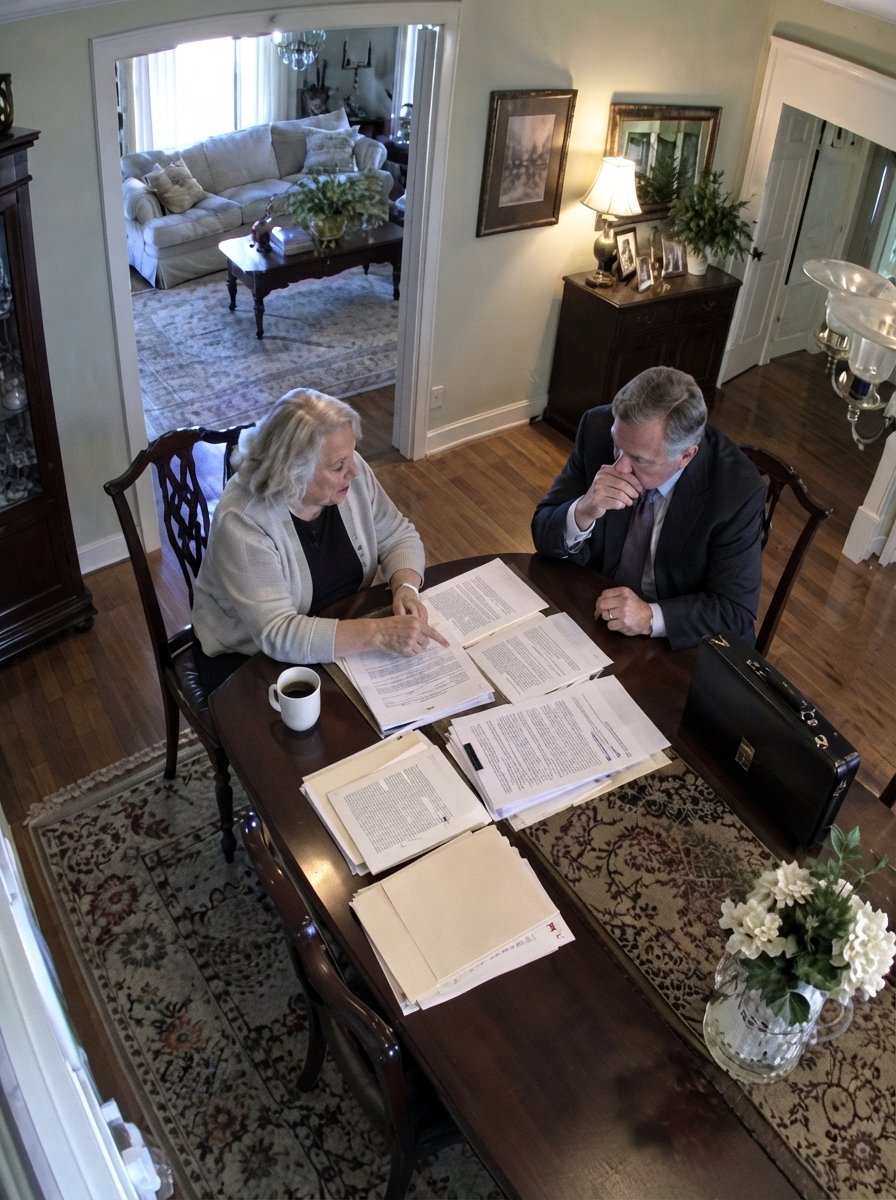
Thomas followed me into the dining room.
I had cleared the old oak table and arranged the trust documents in front of my chair.
He opened his briefcase.
Three folders appeared.
“Before we begin,” he said, “I need to know what you’re considering.”
“I’m considering no longer allowing my children to treat my generosity as a legal obligation.”
He nodded.
“That’s a reasonable place to begin.”
We reviewed the properties.
The first was my home.
The second was Kenneth’s residence.
The third was the San Diego beach house.
All were held through the Gable Family Living Trust, under my authority as sole trustee.
Thomas explained that Kenneth and Brenda had never received ownership of their house.
They had been allowed to live there under a family occupancy arrangement.
The beach house also remained trust property.
Neither could simply be refinanced, sold, or transferred on Kenneth’s authority.
Then Thomas opened a fourth folder.
“This is something we need to discuss,” he said.
Before I could ask what it contained, headlights swept across my dining room windows.
A car door slammed.
Then another.
I looked outside.
Kenneth was marching up the walkway.
Brenda hurried behind him.
My son didn’t bother knocking.
He pushed through the unlocked front door.
“Mom! What the hell are you doing?”
I remained seated.
“Good evening, Kenneth.”
He stopped when he saw Thomas.
“What is he doing here?”
“He’s my attorney.”
“Why do you need an attorney?”
“Why did you need a family meeting to decide I wasn’t welcome at Christmas?”
Brenda appeared in the doorway.
“Evelyn, you’re scaring everyone!”
I folded my hands.
“That’s interesting, Brenda. I was under the impression you didn’t want anything more to do with me.”
She flushed.
“You’re twisting everything.”
Thomas stood.
“Kenneth, please sit down.”
“I’m not sitting down! Mom’s making threats about our Christmas dinner!”
I looked at him.
“Your Christmas dinner?”
“Yes!”
“At your house?”
“Obviously!”
I pushed the second folder toward him.
“Then read this.”
He glanced at the first page.
“The Gable Family Living Trust?”
“That’s right,” Thomas replied.
Kenneth’s expression changed.
“What is this supposed to prove?”
“That your residence has never been titled in your name.”
Brenda stepped closer.
“But Walter promised us that house!”
“He promised you’d always have a home,” I said. “That’s not the same thing as promising you ownership.”
Kenneth sat down heavily.
“You can’t just throw us out.”
“I’m not throwing you out tonight. If the occupancy arrangement changes, Thomas will make sure everything is handled properly and legally.”
I paused.
“But I will no longer subsidize people who believe their relationship with me is optional.”
Brenda burst into tears.
“How could you do this before Christmas?”
I looked straight at her.
**”The same way you could give a thumbs-up when my son threw me out of Christmas.”**
For once, Brenda had no answer.
Thomas cleared his throat.
“Evelyn, there’s another matter.”
He removed the documents from the fourth folder.
“A title company contacted my office last week regarding a proposed refinancing involving two of the trust properties.”
My stomach tightened.
“What refinancing?”
“The submitted paperwork includes an authorization bearing what appears to be your signature.”
“I haven’t signed anything.”
Kenneth sat upright.
“I didn’t apply for a loan against Mom’s properties.”
Brenda turned toward him.
“Kenneth, please don’t.”
Thomas placed a photocopy before me.
There was my signature.
Or rather, a remarkably convincing imitation.
I stared at it.
“I didn’t sign this.”
Then I looked at the name beneath mine.
It belonged to the person seeking authority to proceed with the transaction.
**Gertrude Gable.**
My sister.
For several seconds, nobody spoke.
Then I whispered, “Thomas, why is my sister trying to refinance my houses?”
He took off his glasses.
“That’s what we need to determine.”
Kenneth leaned forward.
“Gertrude said Mom had already agreed to restructure the trust.”
I turned toward him.
“She told you that?”
“Yes.”
“And you believed her?”
He looked away.
Brenda began twisting her wedding ring.
I noticed it because Walter had once told me that people reveal a great deal when they think nobody is watching.
“Brenda,” I said, “what do you know about this?”
She swallowed.
“Gertrude said it was just paperwork.”
“What paperwork?”
“Something about securing financing for the company.”
I looked at Kenneth.
“Does the company need financing?”
He rubbed his forehead.
“Cash flow has been tight.”
“How tight?”
“I don’t know the exact numbers.”
“You are the company president.”
“Mason handles the detailed finances.”
At the mention of Mason’s name, something changed in Thomas’s expression.
It was subtle.
But I noticed.
“What does Mason have to do with this?” I asked.
Kenneth shook his head.
“He said Gertrude knew what needed to be done.”
My chest tightened.
I looked at the three people in front of me.
One was my lawyer.
Two were the son and daughter-in-law who had just rejected me.
And somewhere outside that room, my sister and younger son knew something I did not.
I stood.
“This conversation is finished for tonight.”
Kenneth protested.
“Mom—”
“No. You told me our family relationship was over. Tomorrow we’ll begin sorting out the business relationship.”
Brenda wiped her cheeks.
“Are you seriously going to punish everybody because your feelings got hurt?”
I met her eyes.
**”No, Brenda. I’m going to protect myself because people I trusted have been making decisions involving property they don’t own.”**
Thomas escorted them to the door.
Kenneth turned back once.
For a moment, I thought he might apologize.
Instead, he said, “You’re going to destroy this family.”
I looked at him.
“No, Kenneth. I’m discovering what has already happened to it.”
When the door closed, my legs finally began shaking.
Thomas helped me into a chair.
“You don’t have to make every decision tonight,” he said.
I stared at the forged signature.
“What would Walter have done?”
Thomas was quiet for a long time.
Then he answered.
“He would have followed the documents.”
The next morning, I made another telephone call.
This one was to the fraud department of the title and lending company identified on the refinancing application.
Thomas was present, and together we explained that I was the sole trustee and had not signed or authorized the proposed transaction.
The representative asked several questions, verified my identity, and referred the documents for fraud review.
Processing of the refinancing was suspended pending verification.
Thomas arranged additional notices to the relevant institutions and began reviewing the trust’s property records.
Nothing was instantly transferred or confiscated.
But a transaction that somebody had expected to complete quietly was now under scrutiny.
And that changed everything.
By noon Friday, I had forty-seven missed calls.
Kenneth left a voicemail.
“Mom, you’ve got to call us. This loan situation is serious.”
Brenda sent a message.
“You’re putting our future at risk over a misunderstanding.”
Gertrude wrote:
“Evelyn, we need to talk before you do anything else.”
Mason finally contacted me.
His message was different.
“Mom, I’m sorry things got out of hand. Let me help straighten out the financial paperwork. You don’t need to involve outsiders.”
I read it twice.
Outsiders.
He was referring to Thomas, who had known our family for decades.
I typed back.
“All financial questions will go through Mr. Abernathy.”
Mason responded almost immediately.
“How much has he already seen?”
I looked at those words for a long time.
He hadn’t asked whether I was okay.
He hadn’t asked why I was hurt.
**He wanted to know how much my attorney knew.**
I took another screenshot.
That afternoon, my granddaughter Nora called.
She was nineteen, Kenneth and Brenda’s oldest child, and studying nursing at college.
“Grandma?”
The sound of her voice nearly broke me.
“Hello, sweetheart.”
“Are you okay?”
“I’m managing.”
She started crying.
“Dad says you’re trying to take the house away.”
I closed my eyes.
“Has he told you why?”
“He said you’ve been angry at everyone for months.”
“Nora, I haven’t seen most of you in months.”
There was a pause.
Then she said something that made my heart ache.
“Mom told me you didn’t come to my graduation because you didn’t want to.”
I pressed my hand against my mouth.
“Oh, honey.”
“I thought you were mad at me.”
“No. Never.”
I told her I’d never been invited.
That I’d seen the pictures afterward.
She began crying harder.
“Grandma, I saved you a seat.”
I couldn’t speak.
She whispered, “I kept looking for you.”
For three years, I had believed my grandchildren were growing away from me.
Now I realized somebody had been telling them that I was the one who didn’t care.
Before hanging up, Nora said, “I don’t know what’s happening with Dad and Mom, but I love you.”
After the call, I cried for the first time.
Not because of the house.
Not because of the money.
Because my granddaughter had sat through one of the most important days of her life believing her grandmother had chosen not to attend.
By Friday night, the missed-call counter reached ninety-nine.
I turned the phone off.
On Saturday, Gertrude came to see me.
She looked exhausted.
My older sister had always been the organized one.
Even as children, she kept her pencils sharpened and her socks folded.
Now her gray hair was untidy, and her coat hung crookedly from her shoulders.
“Evelyn,” she said, “you must understand I was trying to help.”
“By signing documents concerning my property?”
She entered the kitchen without waiting to be invited.
“The company needed money.”
“Then why wasn’t I told?”
“Because you would’ve asked questions.”
I stared at her.
“Of course I would’ve asked questions. It’s my property.”
She sat at the table.
“Mason explained that if the company couldn’t access additional financing, there could be layoffs.”
“Why didn’t he speak to me?”
Gertrude looked down.
“He thought you might refuse.”
“So you decided to proceed without me?”
She began crying.
“I believed the paperwork was legitimate. Mason showed me a copy with your signature. He told me you’d agreed in principle.”
“You signed as the person seeking authority to act for the trust.”
“I thought it was a temporary arrangement.”
I wanted to believe her.
But I remembered years of silence.
Every ignored dinner.
Every exclusion.
Every time Gertrude had encouraged me to step away from the family.
“Did you know they were planning to cut me off?” I asked.
She looked at her hands.
“Yes.”
“Did you object?”
“No.”
“Why?”
Her voice became small.
“Because Mason said it might make things easier.”
My heart seemed to stop.
“Easier for whom?”
She didn’t answer.
I stood.
“Go home, Gertrude.”
“Evelyn—”
“Please.”
She gathered her purse and left.
I watched her car disappear down the street.
Then I called Thomas.
**”We need to examine the company’s finances. All of them.”**
The following week, Thomas helped arrange an independent forensic accounting review.
Her name was Julia Reyes.
She was a sharp-eyed woman in her forties who spoke gently but asked questions that made even experienced executives uncomfortable.
We met in Walter’s old office.
His desk was still there.
The same framed photograph of our sons hung on the wall.
Seeing it hurt more than I expected.
Julia spread financial records across the conference table.
“The company has experienced some genuine increases in material costs,” she explained. “But those don’t account for the entire cash shortage.”
“What does?”
She pointed to a column of payments.
“Over the past thirty months, Gable Woodworks has paid substantial sums to a supplier called Harbor West Materials.”
I frowned.
“I’ve never heard of them.”
“They were described as a specialty lumber and logistics vendor.”
“Do we have their contracts?”
“We have invoices. The supporting delivery records are inconsistent.”
“How much money?”
Julia took a breath.
**”Approximately four hundred and thirty-eight thousand dollars.”**
I felt dizzy.
Nearly half a million dollars.
She continued.
“Some invoices were processed through the office under Gertrude’s authorization. Most were approved through the company’s financial systems.”
“By Kenneth?”
“Some had his electronic approval. But the vendor setup and recurring payment instructions came from an administrative account.”
“Whose?”
Julia looked at me.
“Mason’s.”
The room went silent.
Thomas leaned forward.
“Are you certain?”
“The access records indicate his credentials. We still need to establish who controlled the vendor and where the payments ultimately went.”
I stared at Walter’s photograph.
Mason had always been the quiet one.
The dependable one.
The son who repaired my computer and made sure my bills were paid online.
Kenneth demanded attention.
Mason solved problems.
At least, that was what I had believed.
That evening, Mason came to my house.
He carried flowers.
White chrysanthemums.
My favorites.
“Mom,” he said, “I know this has been awful.”
I let him inside.
He hugged me.
For one desperate moment, I wanted to forget everything.
I wanted to believe I still had one son who genuinely cared.
We sat in the living room.
“I’ve been talking to Gertrude,” he said.
I waited.
“She’s frightened. She didn’t mean to hurt you.”
“Did you tell her to sign the refinancing papers?”
He hesitated.
“She misunderstood some things.”
“Did you show her a document with my signature?”
“Mom, there were different drafts.”
“Did you?”
He looked toward the hallway.
“I don’t remember exactly.”
I felt a cold sensation spreading through my chest.
Mason had an excellent memory.
As a child, he could recall telephone numbers after hearing them once.
He remembered every inventory code at the company.
Now he couldn’t remember whether he’d shown our aunt a document supposedly signed by me.
I asked another question.
“Why didn’t you say anything when Kenneth sent that text?”
His face softened.
“I didn’t want to get involved.”
“But you were involved in the trust paperwork?”
“That’s business, Mom. The family disagreement was separate.”
I looked at him.
“Is it?”
He stood abruptly.
“I think you’re letting Thomas turn you against everyone.”
I didn’t argue.
I simply watched him walk to the door.
Before leaving, he turned.
“You know Dad wanted us to have the business eventually.”
I nodded.
“Yes, Mason. Eventually.”
After he left, I remembered a conversation with Walter from the final year of his life.
We had been sitting on the back porch, watching fireflies drift over the garden.
He had recently updated our estate documents.
“Why are you so particular about keeping the houses in the trust?” I’d asked.
Walter had taken my hand.
“Because there’s a difference between giving our boys opportunities and giving them access to everything we’ve earned.”
“Don’t you trust them?”
“I love them.”
I’d laughed.
“That wasn’t my question.”
He had looked across the yard.
“No,” he’d said quietly. “It wasn’t.”
At the time, I thought he was simply being cautious.
Now those words haunted me.
Over the next several weeks, the review deepened.
Kenneth admitted he had approved payments without properly checking the supporting documents.
He said Mason had assured him Harbor West Materials was a legitimate supplier.
Brenda acknowledged that she knew about the proposed refinancing.
She believed the extra financing would stabilize the business and eventually allow her and Kenneth to take ownership of their home.
She also admitted that the family had expected me to sign additional trust paperwork before Christmas.
“Why didn’t anyone ask me first?” I demanded during a meeting with Thomas.
Kenneth stared at the floor.
“Because Mason said you’d turn it into an argument.”
“And you believed him?”
“He said the documents were routine.”
I shook my head.
“There is nothing routine about transferring control over somebody else’s property.”
Kenneth looked at me with red eyes.
“I didn’t know your signature was forged.”
I believed he might be telling the truth about that part.
But I couldn’t forget the text.
“You didn’t need to forge my signature to hurt me, Kenneth. You managed that perfectly well on your own.”
He began crying.
For the first time since Thursday afternoon, he didn’t tell me I was being dramatic.
He simply whispered, “I’m sorry.”
I wanted to reach for him.
Instead, I said, “An apology doesn’t erase what happened.”
As the investigation progressed, the company arranged independent oversight of its finances.
I used an authorized reserve to ensure employees were paid while legitimate business expenses were sorted out.
An experienced operations manager helped keep production moving.
Kenneth agreed to step aside from executive responsibilities while the board reviewed his oversight failures.
Gertrude lost access to the financial systems.
Mason was suspended pending the investigation.
The properties remained under the trust.
Thomas arranged formal reviews of the occupancy agreements and explained the available options without rushing into an unlawful eviction.
I wasn’t interested in humiliating my children.
**I wanted to stop the damage without becoming the cruel person they accused me of being.**
Eventually, Kenneth and Brenda agreed to move into a house they could afford without relying on the trust.
It took time.
They had children, furniture, responsibilities, and a lifetime of habits to untangle.
I didn’t change locks or throw belongings onto the lawn.
Everything was documented and handled through proper procedures.
The beach property was no longer available for their personal vacations.
I also made it clear that I would not guarantee further loans for family members.
Brenda didn’t speak to me for weeks.
Kenneth sent several apologies.
Some sounded sincere.
Others sounded like attempts to negotiate.
I saved them all.
Meanwhile, Nora began visiting me.
We baked together.
We walked through the garden.
She showed me photographs from college, and I listened to stories about her nursing classes.
One afternoon, she brought over the graduation program she’d kept.
Inside was a photograph of her onstage.
On the back, she had written:
“Wish you were there, Grandma.”
I held it against my chest.
“I wish I had been, sweetheart.”
She hugged me.
“You will be at my nursing school graduation.”
I promised her I would.
Then came the discovery that changed everything again.
It was late January when Thomas called and asked me to come to his office.
Julia Reyes was waiting in the conference room.
There was a sealed file on the table.
“Have you identified who controlled Harbor West Materials?” I asked.
Julia nodded.
“We’ve traced the payments through several accounts and obtained additional company records.”
“Was it Gertrude?”
“She participated in processing transactions and received unauthorized payments. She’s responsible for her actions.”
Julia paused.
“But she wasn’t the person directing the arrangement.”
I looked at Thomas.
“Then who was?”
He pushed a document toward me.
It showed corporate registration records, financial correspondence, and digital payment instructions.
A name appeared repeatedly.
**Mason Gable.**
My younger son.
The child I had defended whenever Walter said he worried about Mason’s habit of taking shortcuts.
The son who always offered to handle my computer problems.
The one who had sat silently while Kenneth announced the family was cutting ties.
Julia explained that Mason had created and controlled the supposedly independent supplier through an intermediary.
Payments had been routed through accounts connected to him.
He had used his position in the company to authorize recurring invoices and conceal discrepancies.
Gertrude had helped process the paperwork and had accepted money she should have questioned.
Kenneth had signed approvals carelessly.
But Mason had designed the arrangement.
I stared at the records.
“Why?”
Julia answered carefully.
“Some funds appear to have been used for personal expenses and investments. We don’t yet have a complete accounting of every dollar.”
Thomas added, “The evidence is serious enough that we need to pursue the appropriate legal channels.”
I felt sick.
But Julia wasn’t finished.
“There’s something else.”
She opened another folder.
“This came from a review of the company’s electronic records, preserved after Mason’s suspension.”
Inside was a copy of a document created on Mason’s office computer.
Its title was simple.
“Family Communication Plan.”
I frowned.
“What is that?”
Thomas looked deeply uncomfortable.
“Read the highlighted section, Evelyn.”
I lowered my eyes.
And there, in the middle of the page, were words I recognized immediately.
**”Mom, we’ve discussed this as a family. It’s time for us to cut ties. Please don’t make plans to come to holiday dinners anymore. This is better for everyone.”**
The exact message Kenneth had sent.
Every word.
Every punctuation mark.
I looked at Julia.
“Kenneth wrote that.”
She shook her head.
“The file was created under Mason’s account four days before the message was sent. Its revision history shows him drafting several versions.”
My hands went numb.
Thomas spoke quietly.
“We believe Mason encouraged Kenneth to send the message.”
“Why would he do that?”
Julia turned to another page.
It contained notes describing a proposed strategy for obtaining control of the trust.
One line had been highlighted.
**”If she fears losing family access, she may agree to administrative changes to restore harmony.”**
I read it again.
Then again.
My younger son hadn’t simply stayed silent while my family cut me off.
He had helped arrange it.
He had persuaded Kenneth and Brenda that I was difficult, controlling, and unreasonable.
He had encouraged Gertrude to advance paperwork she didn’t fully understand.
And he had expected me to become so frightened of losing my family that I would surrender control of the trust to make everyone happy again.
My pain had been part of his plan.
**Christmas wasn’t the reason they had pushed me away. Christmas was the pressure point Mason intended to use against me.**
The years of exclusion suddenly looked different.
The missed birthdays.
The graduations.
The family vacations.
The constant suggestions that I was becoming forgetful or difficult.
All of it had created distance between me and the people who might otherwise have noticed what was happening.
Not every cruel decision had been Mason’s alone.
Kenneth and Brenda had made their own choices.
Gertrude had made hers.
But Mason had exploited the resentment and silence.
He had turned family conflict into an opportunity.
And the most devastating part was realizing that he had expected me to beg.
I placed the document on the table.
For a long time, I couldn’t speak.
Then I asked Thomas a question.
“Did Walter know something was wrong with Mason?”
Thomas looked at me sadly.
“Your husband had concerns about financial controls. That’s one reason the trust and company governance documents were structured so carefully.”
I remembered Walter sitting on the porch.
The way he’d squeezed my hand.
The way he had answered “I love them” when I’d asked whether he trusted our sons.
A wave of grief washed over me.
Walter hadn’t been trying to keep our children from inheriting his life’s work.
He had been trying to ensure that inheritance couldn’t be taken before we were ready.
And I had almost undone his protection because I was afraid of hurting our children.
The investigation continued through the proper legal process.
Mason’s financial activities and the disputed property documents were referred to the appropriate authorities.
Civil recovery efforts began.
Gertrude had to answer for her role in processing transactions and seeking authority over my property without my consent.
Kenneth faced the consequences of failing to supervise the company he’d been entrusted to lead.
I couldn’t control how quickly the legal system moved.
And I couldn’t undo the family decisions that had brought us there.
But I could decide what happened next.
I restructured the company’s oversight, strengthening independent financial reviews and giving experienced employees greater responsibility.
Walter’s business had supported dozens of families.
I refused to let it collapse because my own family had confused it with a personal checking account.
And I changed my estate plans.
Not in anger.
Not to punish anyone for refusing to love me.
But because my responsibilities extended beyond the people who shared my last name.
I made provisions for my grandchildren through carefully managed arrangements.
I continued supporting causes Walter cared about.
And I began planning a long-term employee profit-sharing program.
Six months later, Kenneth came to my house.
He stood on the porch holding a small paper bag.
“What’s that?” I asked.
“Apple turnovers. From the bakery you like.”
I almost smiled.
Walter used to bring me the same thing when we had an argument.
Kenneth looked nervous.
“I don’t expect things to go back to normal,” he said.
“They can’t.”
“I know.”
He glanced toward the garden.
“I’ve been thinking about everything.”
I waited.
“I blamed you because it was easier than admitting how much I was getting without ever saying thank you.”
His voice cracked.
“And I let Mason convince me that you were the problem.”
“Kenneth, your brother didn’t force you to send that message.”
“I know.”
He looked at me.
“I chose to send it.”
There was a long silence.
Then he said, “I’m sorry, Mom. Not because of the house. Not because of the company. Because you didn’t deserve what I did.”
I believed he meant it.
But forgiveness and trust are not identical.
“I appreciate your apology,” I said. “Trust will take time.”
He nodded.
“I understand.”
I invited him inside for coffee.
It wasn’t a reunion.
It wasn’t the magical ending people imagine when they talk about family forgiveness.
But it was a beginning.
Christmas came again.
This time, I didn’t wait for an invitation.
I hosted a small dinner at my own house.
Ruth came, carrying a sweet potato casserole.
Nora helped me decorate the dining room.
A few longtime friends joined us.
Kenneth stopped by with a gift and stayed for dessert. We were still learning how to speak honestly to each other.
Brenda sent a card, but our relationship remained distant.
Gertrude and Mason were not at the table.
The legal proceedings and the emotional damage had made that impossible.
I didn’t pretend everything had been healed.
But there was laughter in my house again.
Real laughter.
The kind that didn’t require anyone to feel smaller so someone else could feel important.
After dinner, Nora helped me clear the table.
“Grandma, can I ask you something?”
“Of course.”
“Do you ever wish you’d just answered Dad’s message differently?”
I looked through the window at the garden.
Walter’s old maple tree stood against the winter sky.
For a moment, I thought about the woman I’d been before that Thursday.
The woman who waited by the phone.
Who apologized for things she hadn’t done.
Who believed that being needed was the same as being loved.
Then I looked at my granddaughter.
“No, sweetheart.”
“Not even a little?”
I shook my head.
“Because that message finally showed me what I needed to see.”
She put her arms around me.
“I love you, Grandma.”
I held her tightly.
“I love you too.”
Later that evening, after everyone had gone home, I sat alone at the oak dining table.
The same table where Walter and I had counted pennies during our first years of marriage.
The same table where we’d helped our sons with homework.
The same table where Kenneth had discovered that he didn’t own the house he lived in.
I opened the drawer beside me.
Inside was the screenshot of his original message.
I had printed it months earlier.
Beneath it was the copy of Mason’s communication plan.
One cruel message.
Two different signatures of betrayal.
And one truth I wished I’d learned much sooner.
**The most dangerous person in my family wasn’t the one who told me to leave.**
**It was the one who stayed silent because he had written the words.**
I folded the papers and returned them to the drawer.
Then I switched off the dining room light.
For the first time in years, the silence in my house didn’t feel like loneliness.
It felt like peace.
My children had told me I no longer belonged at their table.
But I’d finally learned something they hadn’t expected me to understand.
**I didn’t need to purchase my place in anyone’s life.**
**And I didn’t have to surrender everything Walter and I had built just to earn the right to be called Mom.**