For my 70th birthday, my daughter-in-law gave me a five-dollar lottery scratch card. She laughed as I scratched away the silver coating, while my son and grandchildren watched. I thanked her politely and kept a straight face when I saw what was hidden beneath it.
I didn’t tell anyone what I had won.
Ten months later, my son showed me a brochure for the retirement community he and his wife had chosen for me without even asking my opinion. I studied the pictures, smiled calmly, and replied, “That seems perfectly fine.”
They looked relieved.
But the following morning, a certified envelope arrived at their front door. When my son opened it and read the documents inside, he looked at me as though I were a complete stranger.
That little lottery ticket had been the only birthday present I received.
“Who knows, Dorothy? Maybe you’ll win enough to afford a bus ticket,” my daughter-in-law, Amanda, joked.
My son, Trevor, burst out laughing.
The grandchildren joined in.
I sat quietly at the table, scratching the ticket while Amanda cut slices of the birthday cake I had made myself.
Then I uncovered something I hadn’t expected.
I stared at the matching symbols.
I looked again.
Then I checked them a second time.
My pulse began racing, but nobody around the table seemed to notice. I carefully folded the ticket and slipped it into the pocket of my cardigan.
Trevor glanced over.
“Didn’t win anything, Mom?”
I gave him a small smile.
“Not even the price of a bus ride.”
That evening, I discovered just how much an elderly woman can hide behind an ordinary smile.
My name is Dorothy Marsh. I was seventy years old, and I had been living under my son’s roof for nearly four years, ever since my husband, Walter, passed away.
Moving in with Trevor had originally been his idea.
“Mom, you shouldn’t have to live by yourself,” he had insisted.
At the time, I believed he genuinely wanted me close. I thought I was joining my son’s household because he loved me and wanted to make sure I was safe.
But gradually, things changed.
I stopped feeling like a member of the family and began feeling more like unpaid household help.
I prepared meals, scrubbed floors, paid for groceries, washed and folded clothes, and looked after the grandchildren whenever they needed someone.
I rarely complained. I told myself that families helped one another, and I was grateful to have a roof over my head.
Then, one evening, I overheard Amanda talking to Trevor.
“Your mother is becoming too much for us.”
Trevor let out a tired sigh.
“What do you expect me to do? She’s still my mother.”
His response hurt more deeply than Amanda’s complaint.
He hadn’t defended me. He hadn’t reminded his wife that I was his mother, the woman who had raised him. He had simply sounded exhausted by the responsibility of having me around.
So when I realized that the inexpensive birthday ticket was actually worth millions, I decided to keep the discovery entirely to myself.
The Five-Dollar Ticket That Changed Everything
The following Monday, I ordered an Uber and traveled downtown to meet an estate-planning attorney named Nathan Brooks.
He carefully examined my winning ticket.
“Have you told anybody about this?” he asked.
“Not a soul.”
“Good. Let’s keep it that way until your finances and legal protections are properly in place.”
Nathan guided me through the process of claiming the prize while maintaining as much privacy as the law allowed. He helped arrange the money, revise my will, and establish several trusts.
The advertised jackpot was $8 million.
After taxes, the amount I actually received was considerably smaller. Still, it was more money than I had ever imagined possessing.
For the first time in my life, I had the financial freedom to make decisions without worrying about every dollar.
But my first priority wasn’t buying expensive clothes or moving into a mansion.
It was protecting my grandchildren’s futures.
I established education trusts for Owen and Lily, structured so that neither Trevor nor Amanda could withdraw or access the funds.
Nathan also gave me one important piece of advice.
“Dorothy, don’t suddenly start living like a millionaire. Take your time.”
And that’s exactly what I did.
I returned to Trevor’s house and continued living as I always had.
I made supper, clipped grocery coupons, folded towels, and put away laundry. Nothing about my daily routine changed.
My family had no reason to suspect that anything was different.
But behind the scenes, I was quietly preparing for a future of my own.
In March, Nathan discovered that the elderly landlord who owned Trevor and Amanda’s rental property was considering selling the house.
I asked him to investigate the opportunity.
Not long afterward, Trevor mentioned something during dinner.
“Apparently, the house was sold. Some company called W&D Property Holdings bought it.”
I nearly smiled.
Those initials meant something special to me.
Walter and Dorothy.
Years earlier, my husband and I had used that name for his small outdoor equipment business.
Trevor had no idea about the connection. To him, it was simply the name of another company that now owned the property.
He continued making his monthly rent payments through a different online system.
I said nothing.
I simply passed him the bowl of mashed potatoes.
Then, in June, I purchased a modest yellow cottage near Savannah, Georgia. It was only twenty minutes away from my sister Frances.
The house had two bedrooms, a beautiful wraparound porch, wild rosebushes in the yard, and a bright kitchen filled with natural light.
It wasn’t extravagant, but it was everything I wanted.
For the first time since Walter’s death, I could picture spending my remaining years somewhere I genuinely felt happy.
Somewhere I wouldn’t be treated as an inconvenience.
Only Frances and the attorneys handling my affairs knew about the cottage.
I hadn’t told Trevor or Amanda.
Then, two weeks ago, my son finally said something that made my decision feel completely certain.
My Son and Daughter-in-Law Had Already Chosen a Retirement Home for Me
We were sitting around the dinner table when Trevor cleared his throat.
“Mom, Amanda and I need to discuss something with you.”
Amanda reached beside her chair and pulled out a glossy brochure.
The cover read Willow Creek Estates.
It was a senior living community.
“We went to see it,” she announced.
I looked at the brochure, then at my son.
They had already visited the place.
Without inviting me.
Without asking whether I wanted to move.
Amanda opened the brochure and pointed to a photograph of a small studio apartment.
“They serve all your meals, provide transportation, and arrange activities. You’d be surrounded by people your own age.”
I slowly turned toward Trevor.
“You’ve been making these arrangements without talking to me?”
He shifted uncomfortably in his chair.
“We figured you’d get upset if we brought it up too early.”
“Have you already made a commitment?”
“Well, not officially.”
I placed my fork on the table.
“And when exactly are you expecting me to leave?”
Trevor hesitated before answering.
“January first.”
It was already the middle of November.
I studied his face.
“Why January first?”
For several moments, neither of them said anything.
Eventually, Trevor admitted the reason.
My grandson Owen wanted to move into the bedroom I was using.
Apparently, they had been discussing the arrangement for months.
Amanda reached across the table and gently patted my hand.
“Dorothy, you’ll enjoy yourself much more at Willow Creek.”
Trevor nodded.
“Really, Mom. This is what’s best for everyone.”
Something inside me suddenly went quiet.
There were no tears.
No anger.
Just an unexpected sense of clarity.
I looked at the brochure once more, then smiled.
“You’re right. I think it’s a good idea.”
The relief on their faces was immediate.
And somehow, seeing how pleased they were at the thought of me leaving hurt even more than the brochure itself.
That night, I called Nathan.
“I’m ready to move forward,” I told him.
Trevor and Amanda were renting the property under a month-to-month agreement. Nathan reviewed the lease and confirmed that, subject to the applicable requirements, we could end the tenancy with thirty days’ notice before arranging to sell the house.
I had finally decided that I no longer wanted my investments connected to relatives who considered me a problem that needed to be removed.
We arranged for the formal notice to be delivered on December 1.
I also asked Nathan to include a personal letter written in my own handwriting.
By November 30, my suitcase was packed and waiting beside my bedroom doorway.
The plan was simple.
A courier would arrive at 9 a.m. the following morning to deliver the documents.
At 10 a.m., a taxi would collect me and take me to the airport.
I was ready to leave quietly.
I didn’t want an argument, a dramatic goodbye, or another conversation about how difficult my presence had become.
But the courier arrived three minutes early.
The Envelope That Changed My Son’s Expression
It was 8:57 a.m. when the doorbell rang.
I was sitting at the kitchen table, enjoying my morning coffee.
Trevor got up to answer the door.
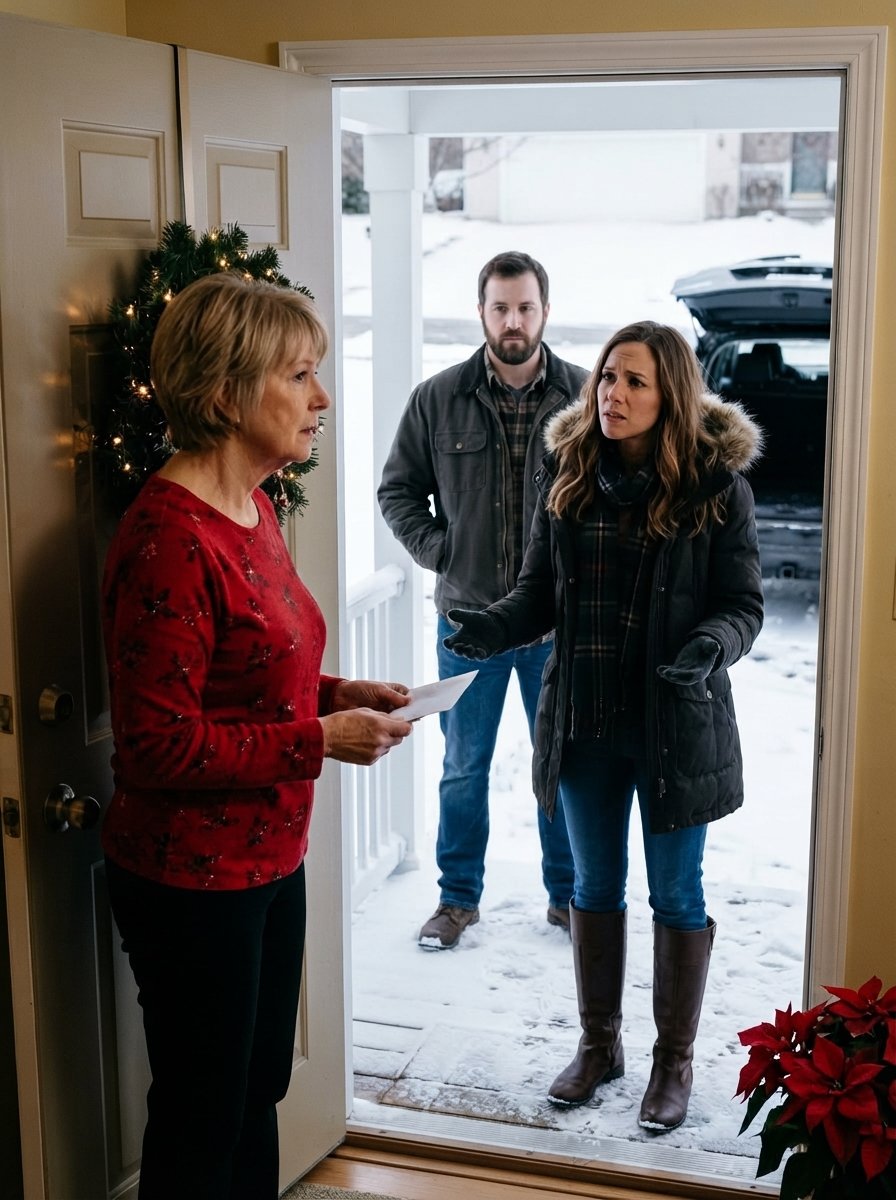
A few moments later, he returned carrying a thick envelope.
He glanced at the sender’s name.
“W&D Property Holdings,” he read aloud.
Then he tore it open.
His eyes moved down the first page. His forehead tightened, and his expression quickly changed.
“What the hell is this?”
Amanda came downstairs at that moment.
She looked at the papers in his hands.
“Trevor? What’s going on?”
He didn’t answer immediately.
I quietly continued drinking my coffee.
Then Amanda snatched the documents from him and began reading.
“Thirty days?” she exclaimed. “Who is Nathan Brooks?”
I took another sip.
I had rehearsed this moment in my mind for months, but that didn’t stop my heart from racing.
A handwritten letter slipped from the final page.
Trevor recognized my handwriting immediately.
“Mom, what is this?” he asked, his voice trembling.
Behind the letter was a photograph of my winning scratch card and the lottery receipt from my seventieth birthday.
I had won eight million dollars.
And W&D Property Holdings belonged to me.
So did the house they had been calling home.
Trevor stared at the photograph as though he couldn’t make sense of what he was seeing.
The documents explained everything.
Nathan Brooks was my legal representative, and the notice informed them that the property would be sold.
For months, I had watched Trevor and Amanda treat me like an inconvenience while unknowingly enjoying the comfort of a home that belonged to me.
Amanda’s eyes filled with tears.
“Dorothy, we only wanted what was best for you.”
I looked at her.
“Did you?”
She began explaining that Willow Creek was a wonderful place and that they had thought I would be happier there.
But I had heard enough.
I reminded her that I had overheard every cruel remark. I had heard her say I was becoming too much for them. I had also heard Trevor’s response, and I remembered how he had failed to defend me when I needed him most.
I wasn’t angry because they had suggested a retirement community.
I was hurt because they had made the decision without me, as though my wishes no longer mattered.
Trevor looked down at the papers.
“What about Owen and Lily?” he asked.
I explained that I had already established education trusts for both grandchildren. Their futures were protected, and neither parent could access the money.
I wanted to make sure the children would have opportunities, regardless of what happened between the adults.
Trevor looked at me.
“Do you hate me, Mom?”
I held his gaze.
“No, Trevor. I don’t hate you.”
I paused before continuing.
“But loving someone doesn’t mean giving them endless financial support. And it certainly doesn’t mean accepting disrespect simply because they’re family.”
For the first time, he seemed to understand what I had been feeling.
He admitted that agreeing with Amanda had been easier than standing up for his own mother.
I listened.
But an apology, no matter how sincere, couldn’t erase years of feeling unwanted.
I Left Without an Argument
That morning, I picked up my suitcase and prepared to leave for my cottage near Savannah.
I didn’t slam doors.
I didn’t shout.
I didn’t argue about who had done what or demand that they understand my feelings.
I simply walked away.
Trevor eventually found a smaller rental property and took a second job to cover his expenses. The house was sold the following spring, forcing him to take responsibility for things he had long expected me to handle.
For the first time, he had to manage his household without assuming I would always be there to help.
Six months later, Trevor arrived at my cottage.
He came alone.
I was sitting on the porch when I saw him approaching.
He looked different. Perhaps it was the weight of everything that had happened, or perhaps he had finally spent enough time reflecting on his choices.
He sat down and apologized.
This time, his words sounded sincere.
He admitted that he had chosen convenience over defending me. He said he should never have allowed me to feel unwanted in the home where I had been helping his family for years.
I listened without pretending the hurt had disappeared.
I couldn’t simply erase what had happened.
But I could see that he was beginning to understand the consequences of his decisions.
And that mattered.
The Best Gift Was Never the Money
The following summer, Owen and Lily came to visit.
We spent the afternoon sitting on the porch, laughing and enjoying the sunshine.
At one point, they found a birthday scratch card and excitedly began scratching away the silver coating.
They won two dollars.
Their excitement was priceless.
I watched their faces light up, and I couldn’t help smiling.
It reminded me of that birthday when Amanda had handed me a five-dollar ticket and joked that perhaps I might win enough money for a bus ride.
Back then, I had no idea that the little card would change my life.
But sitting with my grandchildren, I realized something important.
Happiness didn’t require millions of dollars.
Sometimes, the smallest surprises created the sweetest memories.
I never told my family exactly how much money I still had. I had learned that keeping some things private was not selfish. It was a way of protecting the peace I had worked so hard to find.
I had spent years believing that love meant giving everything I had to the people around me.
Now I understood that real love wasn’t measured by what someone could take from me.
It was measured by how they treated me when they believed I had nothing left to give.